.png)

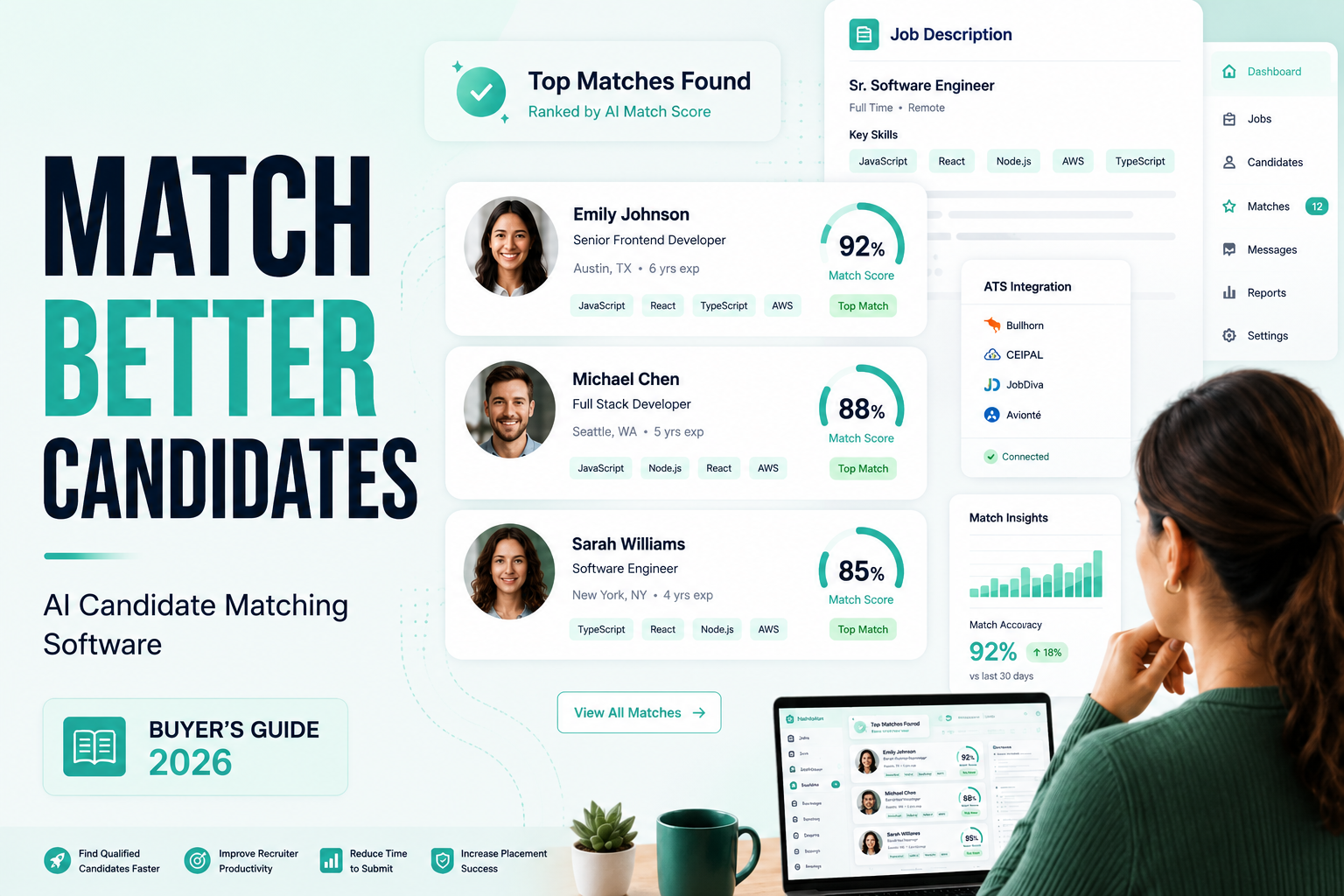
A recruiter receives twenty new resumes for a critical software engineering role before 9 a.m. Another thousand profiles already exist inside the ATS. The challenge isn't finding candidates—it's identifying the right ones quickly.
In high-velocity staffing environments across IT, healthcare, engineering, and commercial desks, the time required to sort through unorganized resume databases represents a direct tax on agency productivity. When delivery teams spend four hours executing complex Boolean queries or skimming through hundreds of off-target profiles, client submission windows close, and competitors secure the placement.
Deploying dedicated AI candidate matching software shifts agency delivery from manual text searching to automated, contextual evaluation. By analyzing candidate experience, skill proximity, and historical placement data, intelligent matching platforms surface qualified talent across your internal ATS and open-web pools in seconds.
Staffing firms operating without intelligent talent matching often suffer from severe operational friction. Recruiters duplicate work, overlook internal candidates who completed assignments months prior, and waste thousands of dollars purchasing external job board credits for talent they already own inside platforms like Bullhorn, CEIPAL, or JobDiva. Adopting a modern candidate matching platform closes these operational leaks and standardizes quality across delivery teams.
What Is AI Candidate Matching Software?
AI candidate matching software is an enterprise technology that uses natural language processing (NLP) and machine learning to analyze job orders and candidate profiles. Unlike manual Boolean search, it understands skill contexts, title equivalencies, and career trajectories. For staffing agencies, this technology cuts resume review times from hours to minutes, surfaces hidden talent inside existing ATS databases, and improves submittal accuracy for competitive VMS and direct-hire roles.
Traditional search tools force recruiters to think like database programmers, relying on rigid Boolean operators (`AND`, `OR`, `NOT`). If a candidate spells a title differently or lists a skill under a related framework, a traditional ATS search skips them entirely. AI candidate matching software addresses this limitation by establishing a deep, semantic understanding of work histories.
For example, when evaluating a role requiring "AWS Infrastructure Management," a semantic matching engine recognizes that a candidate with extensive experience in "Terraform, EC2, IAM, and CloudFormation" is a strong match, even if the explicit phrase "AWS Infrastructure" appears nowhere on their resume.
Furthermore, enterprise candidate matching tools do not evaluate resumes in isolation. They map full career trajectories, measuring how recently a skill was applied, the scope of previous employer environments, project scale, and historic compensation alignment. This contextual evaluation gives account managers high confidence when presenting submittals to strict MSP scorecards or client hiring managers.
How AI Candidate Matching Works
Modern AI candidate matching operates as a multi-stage data processing pipeline designed to convert unstructured job orders and resumes into structured, ranked talent shortlists.
Stage 1: Job Description Parsing & Skill Extraction
The matching engine ingests the client job description, extracting mandatory core requirements, secondary preferred skills, required years of experience, geographic parameters, and tax setups (W2, C2C, 1099). It constructs a dynamic skill map that connects related technical concepts and synonyms.
Stage 2: Resume Parsing & Profile Standardization
Incoming resumes or existing ATS records are parsed and converted into structured candidate profiles. The software normalizes varied job titles, standardizes company names, isolates employment timelines, and indexes technical competencies into searchable data layers.
Stage 3: Semantic Vector Matching
The system compares the job requirement vector against candidate profile vectors. Using neural language models, it measures semantic proximity, ensuring candidates are evaluated based on their actual project contributions rather than keyword frequency.
Stage 4: Explainable Scoring & Recruiter Handoff
Each profile receives a composite match score accompanied by a transparent breakdown explaining why the profile scored well (e.g., "Strong overlap in React and Node.js; 4 years of recent financial services domain experience"). Recruiters can adjust skill weights in real time to refine the shortlist instantly.
Stage 5: Multi-Channel Engagement Integration
Once top matches are confirmed by the delivery team, the platform triggers personalized communication workflows across SMS and email. Reaching candidates through their preferred channels ensures high response rates and faster submittal turnaround.
Traditional Resume Search vs AI Candidate Matching
Relying on traditional keyword search places a strict ceiling on delivery performance. The table below outlines how legacy manual searching compares directly to automated semantic matching across key operational criteria.
| Capability Area | Traditional Boolean / Keyword Search | AI Candidate Matching Engine |
|---|---|---|
| Search Methodology | Exact string matching (`AND`, `OR`, `NOT`) | Semantic concept and contextual skill mapping |
| Handling Title Variations | Requires manual inclusion of every synonym | Automatically groups equivalent industry job titles |
| ATS Candidate Rediscovery | Low; static records sit idle and unsearched | High; background enrichment surfaces past profiles |
| Candidate Scoring | Flat, unranked search results lists | Dynamic, weighted percentage match scores |
| Recruiter Time Spent | 3 to 4 hours per requirement spent building strings | 5 to 10 minutes spent reviewing pre-ranked matches |
| Submission Turnaround | 24 to 48 hours average turnaround | 30 to 60 minutes average turnaround |
Key Features to Look For in AI Candidate Matching Software
Semantic Resume Matching
Ensure the platform understands conceptual relationships between skills, titles, and industries rather than relying strictly on keyword string overlap.
AI Candidate Ranking & Scoring
Automated scoring ranks thousands of applicants objective-by-objective, delivering an ordered list of high-fit profiles directly to the recruiter's primary interface.
Explainable Match Scores
Avoid "black box" AI systems. The software must clearly show why a candidate was ranked high or low, giving recruiters confidence during client conversations.
Automated Candidate Rediscovery
The system should continuously run background scans across your existing ATS database, updating old profiles with fresh external data and flagging past applicants when new orders arrive.
Duplicate Detection & Data Cleaning
Clean up your CRM automatically. High-performing matching tools detect duplicate applicant profiles, merging work history records to maintain unified candidate views.
Bi-Directional ATS Synchronization
Look for native, real-time API integrations with major platforms like Bullhorn, CEIPAL, or JobDiva so candidate match scores, notes, and outreach logs write back automatically.
Custom Weighting & Rubric Controls
Recruiters must have the ability to manually tweak match weights—for instance, increasing the importance of a specific mandatory certification or decreasing location strictness for remote-friendly job orders.
Recruiter Dashboards & Pipeline Analytics
Comprehensive operational dashboards provide recruiting managers with visibility into sourcing channels, candidate response rates, match score accuracy, and time-to-submit trends across delivery desks.
Benefits for Staffing Agencies
Higher Recruiter Productivity
By automating manual database searches and preliminary profile filtering, recruiters spend less time digging through spreadsheets and more time interviewing qualified talent and closing placements.
Reduced Job Board Overhead
Reactivating existing candidate profiles inside your ATS through candidate rediscovery allows your firm to decrease reliance on expensive external resume databases and job board credits.
Improved Submittal-to-Interview Ratios
Contextual semantic scoring ensures that submitted candidates align closely with client expectations, driving down rejection rates and strengthening agency relationships with enterprise account managers.
Consistent Quality Across Junior & Senior Recruiters
Traditional Boolean sourcing relies heavily on individual recruiter skill and domain knowledge. Semantic matching standardizes search precision across the entire floor, allowing junior sourcers to deliver candidates with senior-level accuracy.
Enhanced Candidate Experience
When candidates are matched to opportunities that align closely with their background and career goals, outreach messages feel personalized and relevant, leading to higher engagement and stronger talent retention.
ATS Integrations
AI candidate matching tools should operate directly within your existing system of record rather than forcing recruiters to manage separate software dashboards.
| Supported ATS / CRM Platform | Integration Depth | Primary Data Flow |
|---|---|---|
| Bullhorn | Native Bi-Directional API | Auto-enrichment, match score write-back, status trigger sync |
| CEIPAL | Native Bi-Directional API | Automated pipeline creation, SMS outreach sync, profile updates |
| JobDiva | Direct API Hook | Candidate score logging, submittal attachment sync |
| Avionté | Direct API Hook | Talent pool enrichment, high-volume contract matching |
| Enterprise (Greenhouse, Lever, Workday) | Enterprise Webhooks & API | RPO pipeline sync, executive search scorecards |
Why Deep Integration Matters
Without seamless bi-directional synchronization, recruiters are forced to manually copy notes, download resumes, and re-enter match scores across separate browser tabs. Native integration ensures that all candidate activity, communication history, and match scores are written directly back to your central CRM, preserving data integrity and audit compliance.
Industry Use Cases
IT & Technology Staffing
Scenario: A high-volume MSP requirement demands a Senior DevOps Engineer with niche Kubernetes, Terraform, and AWS security experience.
Matching Impact: The semantic matching engine scans 5,000 historical ATS records, surfaces 12 past contractors whose current assignments are ending, ranks them by technical overlap, and triggers automated SMS availability checks within 15 minutes.
Healthcare & Allied Staffing
Scenario: Urgent requirement for 25 travel nurses with active Compact RN licenses and specific ICU certifications.
Matching Impact: The AI engine filters candidate profiles by active state licensure, shift availability, and ACLS/BLS credentials, presenting an immediate shortlist of compliant nurses ready for screening calls.
Engineering & Commercial Staffing
Scenario: High-volume plant expansion requiring 40 CNC Machinists with 5-axis machine experience.
Matching Impact: Automatically parses local talent pools, evaluates commute distance constraints, and verifies shift preferences to build a ready-to-interview pipeline.
Finance & Professional Services
Scenario: Seasonal demand for 15 Senior Tax Accountants with SEC filing experience and CPA credentials.
Matching Impact: The platform cross-references past tax season contractors, verifies current employment status, and ranks candidates by relevant industry domain depth.
Executive Search & Direct Placement
Scenario: Retained search for a Vice President of Supply Chain within a global manufacturing firm.
Matching Impact: Matches complex leadership rubrics, analyzing career progression, team scale management, international logistics background, and executive competencies.
AI Candidate Matching vs Related Technologies
1. AI Matching vs Boolean Search
| Dimension | Boolean Search | AI Candidate Matching |
|---|---|---|
| Query Structure | Manual string creation (`AND`/`OR`) | Natural language job description intake |
| Skill Context | Literal keyword presence only | Evaluates depth, recency, and skill proximity |
2. AI Matching vs Resume Parsing
| Dimension | Resume Parsing | AI Candidate Matching |
|---|---|---|
| Primary Function | Extracts text into database fields | Evaluates extracted data against job orders |
| Output | Structured profile record | Ranked fit score with match explanation |
3. AI Matching vs Candidate Screening
| Dimension | AI Candidate Matching | AI Candidate Screening |
|---|---|---|
| Operational Timing | Top-of-funnel discovery & ranking | Mid-funnel verification (Voice/SMS/Chat) |
| Key Outcome | Identifies who to contact first | Verifies pay rate, visa, and start date availability |
4. AI Matching vs Candidate Rediscovery
| Dimension | Candidate Rediscovery | AI Candidate Matching |
|---|---|---|
| Focus Area | Reactivating old CRM database profiles | Ranking profiles against a specific requisition |
| Scope | Data enrichment & status updating | Direct job alignment scoring (ATS + Web) |
5. AI Matching vs Job Boards
| Dimension | Job Boards | AI Candidate Matching Software |
|---|---|---|
| Model | Pay-per-posting or resume search credits | Software platform that leverages owned assets |
| Data Ownership | Third-party candidate access | Maximizes agency-owned talent database value |
Implementation Best Practices for Staffing Leaders
- Data Health Audit: Clean up legacy ATS records and resolve duplicate candidate profiles prior to system configuration.
- Standardize Job Intake: Establish clear job description templates so the parsing engine receives structured skill parameters.
- Configure API Write-Back: Set up bi-directional synchronization with Bullhorn or CEIPAL to eliminate manual data entry.
- Train on Explainable Scores: Educate recruiters on how to interpret match rationale and adjust skill weightings.
- Measure Baseline ROI: Track submittal speed, job board credit savings, and placement fill rates monthly.
- Establish Governance & Bias Oversight: Conduct periodic audits on scoring rubrics to ensure compliant, objective evaluations.
How NinjaHire Supports AI Candidate Matching
NinjaHire delivers an enterprise-grade AI recruiting and talent intelligence platform engineered specifically for contract, IT, healthcare, and commercial staffing agencies.
By pairing semantic candidate matching with automated multi-channel engagement and conversational AI phone screening, NinjaHire enables delivery desks to move from open job order to qualified client submittal in minutes.
Frequently Asked Questions
What is AI candidate matching software?
AI candidate matching software is an enterprise recruiting tool that uses natural language processing and machine learning to analyze job descriptions and candidate resumes, automatically ranking profiles based on contextual skill fit and career experience.
How does AI candidate matching differ from Boolean search?
Boolean search relies on exact keyword string operators, often missing qualified candidates who use different job titles or phrasing. AI candidate matching uses semantic analysis to understand the underlying concepts and skill relationships across a profile.
Can AI candidate matching search my existing ATS?
Yes. Leading platforms integrate directly with systems like Bullhorn, CEIPAL, and JobDiva, running automated scans to rediscover historical candidate profiles and update stale records continuously.
How accurate is AI candidate matching software?
By evaluating contextual skill usage, recent project history, and career trajectories, modern AI matching engines deliver significantly higher submittal accuracy than traditional keyword filters, reducing client rejection rates.
Does AI candidate matching replace human recruiters?
No. AI candidate matching automates the time-consuming administrative task of searching and sorting resumes, allowing recruiters to focus on candidate conversations, interview preparation, and relationship management.
Which ATS platforms support AI candidate matching integrations?
Enterprise platforms offer bi-directional API write-back for major staffing and recruiting ATS systems including Bullhorn, CEIPAL, JobDiva, Avionté, Greenhouse, Lever, and Workday.
How does AI candidate matching improve recruiter productivity?
By instantly surfacing ranked shortlists of pre-qualified talent, recruiters save 3 to 4 hours per job order previously spent writing search queries or filtering resumes manually.
What is candidate rediscovery in recruitment software?
Candidate rediscovery automatically scans historical resumes sitting idle in your ATS, enriching old contact details and skill sets with fresh web data to match them against new client requisitions.
Is AI candidate matching suitable for contract staffing?
Yes. It is exceptionally effective for high-velocity contract, W2, and C2C roles where submittal speed directly determines which agency wins the placement inside VMS portals.
What is explainable match scoring?
Explainable match scoring provides recruiters with a transparent breakdown showing exactly why a candidate received a high or low ranking, highlighting skill overlaps, industry experience, and potential gaps.
How does AI candidate matching handle skill recency?
Advanced neural models weight recent project experience heavier than skills used years ago, ensuring that candidates actively practicing a technology are prioritized over those with outdated experience.
Can recruiters manually adjust AI matching weights?
Yes. Delivery managers can customize scoring rubrics by marking specific certifications, locations, or technical tools as mandatory or optional to refine the shortlist instantly.
Ready to accelerate your candidate matching pipeline?
Discover how semantic candidate matching and automated ATS rediscovery eliminate manual sourcing bottlenecks for high-volume delivery desks.
Book a Live Platform Demo