.png)

By Senior US Staffing Consultant & Tech Strategist
The first phone screen often determines whether a recruiter spends the next few days working with the right candidate—or loses hours on someone who was never a fit. In the fast-moving staffing market, every wasted minute on an unvetted profile delays your submittal and increases the risk of a competitor winning the placement.
Delivery teams at IT, healthcare, and engineering agencies routinely deal with bloated pipelines. They spend hours playing phone tag to confirm basic information: pay rate expectations, work authorization, shift preferences, or commuting limits. When recruiters spend 60% to 70% of their day asking the same ten qualification questions, productivity drops and candidates slip through the cracks.
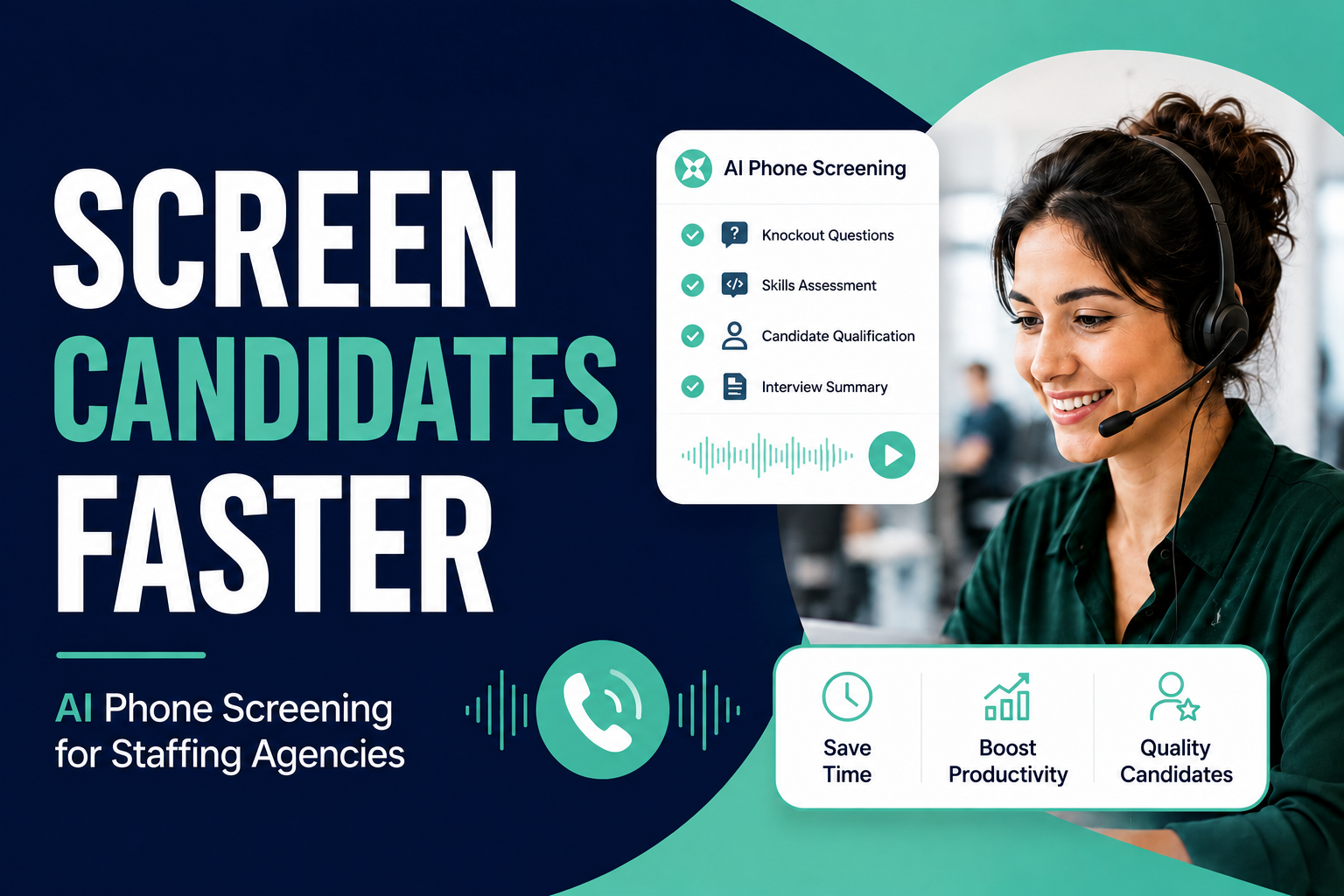
AI phone screening software for staffing agencies addresses this operational bottleneck by automating early-stage candidate conversations over the phone. Using conversational voice AI, these platforms conduct initial intake calls, ask customized knockout questions, assess technical competencies, and sync summaries directly to your applicant tracking system (ATS).
Instead of replacing the human touch, automated voice screening ensures your recruiters spend their time on high-value conversations: building relationships, prepping candidates for client interviews, and closing offers.
What Is AI Phone Screening Software?
Definition for Staffing Firms: AI phone screening software for staffing agencies is an enterprise technology that uses conversational voice AI, natural language processing (NLP), and automated workflows to conduct real-time, interactive phone interviews with candidates. It evaluates candidate qualifications, verifies employment parameters, and logs structured interview summaries into an agency’s recruitment CRM or ATS.
In a staffing environment, phone screening is distinct from corporate HR interview tools. Corporate HR teams use screening tools to narrow down hundreds of inbound applicants for a single open role. Staffing firms, by contrast, need speed, volume, and precision to place contract (W2, C2C, 1099) and direct-hire talent across multiple client requirements simultaneously.
An AI voice recruiter initiates outbound calls or receives inbound calls from candidates, engaging in a natural, two-way dialogue. It doesn't just read a rigid script; it listens, processes responses, asks dynamic follow-up questions, and evaluates answers against specific client requirements.
Key Elements of AI Voice Screening in Staffing
- Conversational Voice AI: Uses natural voice engines that handle realistic cadence, pauses, and variations in candidate answers.
- Knockout Questions: Immediately identifies deal-breakers such as missing certifications, salary mismatches, or lack of work authorization.
- Adaptive Follow-ups: Probes deeper if a candidate gives a vague answer regarding project experience or technical skills.
- Structured Output: Converts unstructured voice conversations into clean candidate scorecards and transcriptions inside systems like Bullhorn, CEIPAL, or JobDiva.
Why Staffing Agencies Are Adopting AI Phone Screening
Staffing agency operations are fundamentally constrained by time. A recruiter working a 10-hour day can physically make only a limited number of screening calls. When client VMS (Vendor Management System) portals release high-volume requirements with tight submittal deadlines, manual phone screening creates an immediate operational capacity ceiling.
The Cost of Manual Phone Screening
The traditional phone screen is full of operational friction:
- Unreturned Calls and Voicemails: Recruiters spend hours calling candidates who do not answer, leaving voicemails, and waiting for callbacks.
- Off-Hours Availability: Candidates who are currently employed—especially passive candidates or night-shift healthcare workers—are rarely available to talk between 9:00 AM and 5:00 PM.
- Inconsistent Screening Quality: Different recruiters ask different questions, leading to uneven candidate evaluations and inconsistent submittal packages.
- Administrative Overload: Recruiters must manually type up screen notes, update status fields, and attach records to the ATS after every call.
The Impact of VMS Speed and Volume
In contract staffing, landing in the first wave of submittals inside a VMS portal like Fieldglass or Beeline often dictates which agency gets the interview slots. If your team takes 24 to 48 hours to manually screen five candidates, another agency using recruitment automation software will have already submitted ten vetted contractors.
AI phone screening allows agencies to scale their outreach instantly. When a requirement drops, an agency can initiate 50 or 500 phone screens simultaneously, qualifying an entire pipeline in minutes rather than days.
How AI Phone Screening Works
To understand how voice AI integrates into daily recruiting operations, let's look at the end-to-end workflow from requirement receipt to candidate submittal. For an extended technical look at these operational stages, review our detailed guide on how AI phone screening works end-to-end with real examples.
Stage-by-Stage Workflow Breakdown
- Job Requirement Processing: The agency receives a new job order from a direct client or VMS. The account manager or recruiter sets up the screening criteria, defining required skills, knockout parameters, and target pay rates.
- Sourcing & Triggering the Screen: Candidates are sourced from internal ATS databases, job boards, or passive sourcing channels. The recruiter selects a candidate batch and triggers the AI screening workflow.
- Outbound/Inbound Voice Engagement: The AI system dials the candidate or sends an SMS link allowing the candidate to request an immediate call or schedule a convenient time.
- Knockout & Qualification Verification: The AI opens the conversation naturally, verifies the candidate's identity, and runs through core knockout criteria (e.g., C2C vs. W2, shift preferences, active certifications). Modern setups also incorporate security checks against deepfake voice fraud in phone-based AI screening to ensure identity validity.
- Technical & Experience Evaluation: If the candidate passes knockout criteria, the AI transitions into role-specific questions, asking about recent project history, tools used, and problem-solving scenarios.
- Summary Generation & Scoring: Once the call concludes, the AI engine transcribes the audio, generates a concise summary, scores the candidate against the job parameters, and highlights key answers.
- ATS Synchronization: The complete transcript, call recording link, scorecard, and status update are instantly pushed into the agency’s ATS (such as Bullhorn, CEIPAL, or JobDiva).
- Recruiter Review & Final Submission: The recruiter reviews the top-scored candidates, listens to relevant snippets of the call if needed, conducts a brief closing conversation, and submits the qualified candidate to the client.
What AI Phone Screening Can Evaluate
AI voice screeners are designed to handle both hard operational requirements and nuanced, qualitative communication. Below is a breakdown of what the software can effectively evaluate during a candidate conversation.
Availability & Start Date
Verifies when the candidate can realistically start, accounting for notice periods or existing contract end dates.
Notice Period
Identifies if a candidate must give two weeks' notice, four weeks' notice, or can start immediately on a W2 or C2C basis.
Salary Expectations
Confirms target hourly bill rates, annual salary expectations, and flexibility regarding overtime or shift differentials.
Visa Status & Work Authorization
Screens for clear work authorization (US Citizen, Green Card, EAD, H-1B, C2C vendor setup) without asking non-compliant questions.
Technical Skills
Asks targeted technical questions, evaluating whether a developer or engineer actually used a tool in a recent project or just listed it on their resume.
Communication Skills
Assesses spoken language clarity, professional tone, and responsiveness—critical for client-facing or customer support roles.
Project Experience
Evaluates recent project scale, team size, tools used, and core operational milestones from recent roles.
Shift Availability & Location
Confirms willingness to work night shifts, weekend rotations, on-call schedules, or specific local time zones, verifying commute limits or hybrid work constraints.
Core Features
When evaluating AI candidate screening software, staffing leadership should look for features tailored to high-velocity agency workflows rather than generic interview tools.
1. Natural AI Voice Conversations
Modern voice engines use low-latency Speech-to-Text (STT) and Text-to-Speech (TTS) models that converse in natural, human-like tones. They handle interruptions, pauses, and variations in accents without dropping the call logic or sounding like a rigid IVR menu.
2. Dynamic Follow-up Questions
If a recruiter asks, "Have you worked with AWS?" and the candidate simply says "Yes," a human recruiter would follow up with "Which specific services did you use?" Advanced AI phone screeners do the exact same thing, probing deeper into vague answers to ensure technical claims are real.
3. Resume-Based Interviews
The software reads the candidate's uploaded resume prior to initiating the call. It customizes its questions based on their specific work history—for example, "I see you worked as a Senior Java Developer at Bank of America until last month. Were you using Java 17 and Spring Boot on that microservices project?"
4. Real-Time Transcription and Summaries
Every call is transcribed in real time. The AI generates a structured candidate summary that highlights key answers, flags potential concerns (such as rate mismatches), and provides timestamped audio links so recruiters can review specific answers in seconds.
5. Candidate Scoring and Ranking
The system evaluates answers against predefined rubrics and ranks candidates on a clear scale (e.g., 1 to 100 or A/B/C tiering). This allows delivery managers to immediately see the top candidates in their ATS pipeline without reviewing every record manually.
6. ATS Synchronization
Bi-directional integration ensures that candidate statuses, interview scores, full transcripts, and call recordings flow seamlessly into systems like Bullhorn, CEIPAL, JobDiva, Greenhouse, or Lever. Recruiters never have to leave their primary workspace to access screening data.
7. Interview Scheduling
When a candidate passes all knockout criteria and achieves a high screening score, the AI can automatically offer available calendar slots for a detailed follow-up interview with the primary recruiter, eliminating back-and-forth scheduling emails.
8. Multi-Language Support
For light industrial, commercial, hospitality, or international healthcare recruiting, AI screeners can conduct interviews in multiple languages (such as English, Spanish, French, or Tagalog), seamlessly translating responses into standardized English summaries for the recruiter.
Benefits for Staffing Agencies
Deploying AI candidate screening software transforms the economics and speed of a staffing production floor.
Faster Screening and Unmatched Speed
In contract recruiting, submission speed is paramount. Automated voice screening allows your team to contact, screen, and score dozens of applicants within minutes of a VMS order going live. Winning the race to early submittals directly translates to higher placement rates.
Higher Recruiter Productivity
When recruiters are freed from performing repetitive 15-minute preliminary screens, their capacity expands dramatically. A delivery manager who previously managed 3 open job orders can comfortably handle 8 to 10 requirements because their time is spent entirely on high-probability submittals.
Reduced Administrative Work
Manual note-taking, logging phone calls, and writing candidate submission summaries consume hours of recruiter time. AI screening platforms automate data capture completely, pushing clean, professionally formatted summaries directly into the agency's ATS.
Better Candidate Quality and Consistency
Human recruiters have off days, skip questions when rushed, or evaluate candidates based on subjective personal bias. AI voice screening asks every candidate the same core qualification questions, ensuring consistent compliance, unbiased scoring, and reliable submittal packages for your clients.
Traditional Phone Screening vs AI Phone Screening
To understand the operational contrast, let's look at how traditional manual screening compares to AI-assisted voice screening across core delivery metrics.
| Performance Area | Traditional Manual Screening | AI Phone Screening Software |
|---|---|---|
| Screening Capacity | Limited to 8–12 calls per recruiter per day | Hundreds of screens executed concurrently |
| Turnaround Time | 24 to 48 hours to complete candidate pool | 15 to 30 minutes for an entire shortlist |
| Availability | Restricted to standard business hours (9 AM–5 PM) | 24/7/365 screening capability |
| Documentation | Manual, abbreviated, inconsistent ATS notes | Complete transcripts, audio, and AI summaries |
| Evaluation Bias | Inconsistent questions; subject to recruiter fatigue | Standardized questions and objective scoring |
| Candidate Experience | Phone tag, delayed feedback, missed callbacks | Immediate engagement, flexible self-scheduling |
Realistic Recruiter Scenarios
To see how AI phone screening works in practice, let's examine three real-world staffing scenarios across IT, healthcare, and manufacturing.
Scenario 1: IT Staffing (Java Microservices Developer for C2C Role)
The Challenge: An IT staffing firm receives an urgent requirement from a major financial services MSP for a Senior Java Microservices Developer. The role is open to C2C candidates, but the bill rate is tight ($75/hr max), and candidates must have hands-on experience with AWS, Spring Boot, and Kafka.
The Execution: The recruiter uploads 40 candidate profiles from Bullhorn into the AI phone screening tool. The AI initiates outbound screens. Within 20 minutes, it interviews 18 available developers.
The Result: The AI asks knockout questions regarding C2C vendor setup, verifies target pay rates, and asks specific technical questions about Kafka event handling. It identifies 4 developers who meet all rate and technical criteria, flags 2 candidates who demanded $90/hr, and auto-generates scorecards. The recruiter submits the top 3 candidates to the VMS within 45 minutes of job release.
Scenario 2: Healthcare Staffing (Travel Nurse - ICU)
The Challenge: A healthcare staffing agency needs to fill a night-shift ICU travel nurse position at a hospital in Texas. Travel nurses are typically on shift during the day and difficult to reach during regular office hours.
The Execution: An ICU nurse applies through a job board at 8:30 PM. The AI phone screening system automatically texts the nurse, offering an immediate call. The nurse accepts, and the AI voice screener initiates the call.
The Result: The AI verifies that the nurse holds an active Texas compact RN license, confirms their BLS/ACLS certifications, verifies they can work 12-hour night shifts, and checks their target weekly stipend expectations. By 8:45 PM, a complete screening record and audio summary are attached to the candidate profile in CEIPAL, and an interview is booked on the recruiter's calendar for the following morning.
Scenario 3: Light Industrial & Manufacturing (CNC Machinist)
The Challenge: A manufacturing staffing agency needs to recruit 15 CNC Machinists for a multi-shift plant expansion. The job requires specific experience with 5-axis machines, safety certifications, and willingness to work 2nd shift.
The Execution: The agency runs local social media and job board ads with a dedicated phone number. When applicants call the number, the AI voice recruiter picks up immediately.
The Result: The AI asks applicants about their CNC machine experience, verifies safety credentials, confirms their commute distance, and checks 2nd-shift availability. Qualified applicants are automatically texted a link to schedule an in-person shop floor audit, while unqualified callers are politely notified of the role's mandatory requirements.
Industry Use Cases
IT Staffing
IT staffing requires fast validation of technical stacks, employment setups (W2 vs. C2C vs. 1099), visa status, and hourly rate alignment. AI screeners evaluate whether candidates have actual hands-on development experience or merely passive familiarity with specific frameworks.
Healthcare Staffing
In healthcare staffing (nursing, allied health, locum tenens), compliance is everything. AI voice screening verifies active state licenses, compact status, mandatory certifications (BLS, ACLS, PALS), shift preferences, and travel stipend expectations before recruiters invest time.
Engineering
Engineering roles often require specific degree verifications, software proficiency (SolidWorks, AutoCAD, Revit), project portfolio reviews, and security clearance validations (Secret, Top Secret). AI phone screeners systematically check these parameters during initial intake.
Light Industrial & Manufacturing
High-volume commercial staffing relies on rapid screening for attendance reliability, shift flexibility, physical job requirements, drug screen agreement, and reliable transportation. Automated phone screening processes hundreds of applicants daily to keep talent pipelines full.
Finance & Customer Support
For accounting, finance, and customer support staffing, AI voice screeners assess professional communication skills, software familiarity (Excel, ERP systems, Salesforce), financial certifications (CPA, Series 7), and compensation expectations.
ATS & VMS Integrations
AI phone screening software should not operate as a standalone island of data. To maximize recruiter adoption, the platform must connect directly to your agency's existing recruitment technology stack.
Leading platforms integrate natively with:
- Bullhorn: Syncs notes, call recordings, scorecards, and updates candidate submission statuses in real time.
- CEIPAL: Automatically logs screening results, updates candidate placement stages, and triggers follow-up workflows.
- JobDiva: Attaches call transcripts directly to candidate submittal profiles for quick account manager review.
- Greenhouse & Lever: Pushes structured interview scorecards and candidate ratings straight into candidate stage pipelines.
- Workday, Fieldglass, & Beeline: Connects candidate data directly across enterprise MSP accounts and VMS order portals.
How NinjaHire Uses AI Phone Screening
NinjaHire provides an enterprise-grade AI recruiting platform designed specifically for the fast-paced demands of staffing agencies, RPOs, and contract delivery teams.
NinjaHire features an AI voice recruiter that executes conversational calls, manages knockout logic, conducts technical evaluations, auto-summarizes recordings, and updates ATS records bi-directionally. By combining this with multi-channel recruiting workflows, delivery floors scale submittal output while maintaining full recruiter oversight over candidate relationships.
Frequently Asked Questions
What is AI phone screening software?
AI phone screening software for staffing agencies is an automated voice technology that conducts interactive, conversational phone interviews with candidates. It asks job-specific qualification questions, checks knockout criteria, evaluates technical background, and logs structured summaries directly into an agency's ATS.
Can AI replace recruiter phone calls?
No. AI phone screening is designed to replace early-stage, repetitive qualification calls—not the entire recruiter relationship. The software completes the initial administrative intake, allowing human recruiters to step in for high-value discussions, client interview preps, rate negotiations, and closing calls.
Can AI ask technical questions during a phone screen?
Yes. Modern AI voice screeners can evaluate technical responses by matching candidate answers against technical domain rubrics. If a candidate gives a brief or ambiguous answer regarding a framework or tool, the AI asks dynamic follow-up questions to test the actual depth of experience.
How accurate is AI phone screening software?
AI phone screening platforms utilize speech-to-text models optimized for accents, technical terminology, and industry jargon. Coupled with dynamic natural language processing, these platforms deliver speech recognition accuracy rates comparable to human transcribers, ensuring candidate evaluations are reliable and objective.
Does AI phone screening integrate with Bullhorn?
Yes. Leading voice screening platforms feature native, bi-directional Bullhorn integrations. When an AI screen is completed, the full transcript, candidate summary score, audio link, and updated pipeline stage are pushed automatically into Bullhorn.
Can AI screen contract candidates?
Yes. AI phone screening is particularly effective for contract staffing (W2, C2C, 1099). The AI can systematically verify tax setup requirements, corp-to-corp vendor details, hourly rate flexibility, and immediate availability before passing the candidate to a recruiter.
Can recruiters customize questions?
Yes. Delivery managers and recruiters can customize question scripts, knockout rules, and evaluation rubrics for every individual job requirement. They can also use pre-built templates for common roles across IT, healthcare, engineering, and commercial staffing.
How does AI improve recruiter productivity?
By automating the preliminary screening process, recruiters no longer waste hours making cold calls, leaving unreturned voicemails, or asking repetitive intake questions. This allows recruiters to focus exclusively on pre-qualified candidates, effectively doubling or tripling their daily submittal capacity.
Can AI schedule interviews?
Yes. Once a candidate completes the AI phone screen and passes all required qualification thresholds, the software can present available calendar slots and book a follow-up interview directly onto the primary recruiter's calendar.
Does AI support multiple languages?
Yes. Many advanced voice screening engines support multi-language conversations (e.g., English, Spanish, French). This is particularly useful for commercial, light industrial, hospitality, and healthcare staffing agencies managing diverse candidate pools.
Ready to scale your candidate screening pipeline?
Experience how conversational voice AI and bi-directional ATS automation eliminate screening bottlenecks and accelerate client submissions.
Start Free Trial or Book a Demo