.png)

For contract staffing agency leaders and delivery managers, the core operational hurdle is rarely an absolute lack of resumes. Instead, the real bottleneck is identifying verified, available contractors, confirming bill and pay rate alignment, and securing candidate commitment before competing vendors submit matching profiles to the exact same client portal.
In high-velocity contingent hiring environments governed by Managed Service Providers (MSPs) and Vendor Management Systems (VMS), submittal windows often close rapidly. When your recruitment team spends hours manually constructing Boolean searches, parsing outdated candidate records, and leaving unanswered voicemails, competing agencies are already booking interview slots.
Whether your firm delivers W2 contractors, C2C technical consultants, or 1099 specialists across IT, healthcare, engineering, or light industrial staffing, your profitability hinges on submittal velocity and candidate match accuracy. Achieving this cadence at scale requires operational workflows built specifically around AI recruiting software for contract staffing agencies.
This comprehensive guide details why contract recruiting requires a fundamentally different software approach than permanent placement, how recruitment automation resolves delivery bottlenecks, how semantic matching and automated screening operate in production, and how staffing firms measure tangible ROI.
Contract placements favor agencies that rapidly identify and present qualified contractors to VMS portals within the opening submittal window.
Agencies surface available talent already stored in Bullhorn, CEIPAL, or JobDiva rather than constantly repurchasing external job board credits.
Automated initial screening and rate confirmation expand recruiter requisition capacity without requiring linear internal recruiter headcount growth.
Why Contract Staffing Demands Dedicated AI Recruiting Software
Contract staffing and permanent corporate talent acquisition operate under entirely distinct operational realities. Corporate talent acquisition teams often take 30 to 60 days to evaluate culture fit and complete multiple interview rounds for a single permanent employee. In contrast, a contract staffing firm must source, qualify, and submit matching contractors within hours to satisfy client SLAs and secure interview slots.
Because contingent workforce revenue depends directly on billable contractor hours, vacant contract requisitions represent immediate and unrecoverable billing losses. Standard recruiting workflows struggle with the specific mechanics of contingent staffing for several structural reasons:
- Perishable Contractor Availability: Qualified contingent professionals actively seeking an assignment are typically on the market for a very short duration. If an agency requires several days to conduct initial manual sourcing, top contractors have often already accepted competing offers.
- Rapid ATS Data Decay: Staffing agencies accumulate hundreds of thousands of candidate profiles over years of operation. However, contractor availability dates, compensation expectations, newly acquired technical certifications, and contract completion statuses change frequently, leaving static ATS databases dormant without automated rediscovery.
- Strict VMS Submission Rules: Enterprise contingent programs route requisitions through VMS platforms such as SAP Fieldglass, Beeline, or Coupa. Many enterprise programs limit submittals to the first few matching candidates or score staffing suppliers on submittal response time, making manual keyword searches a competitive liability.
- Rate and Margin Constraints: Compressed MSP bill rates demand that staffing agencies protect gross margins by keeping delivery costs low. Recruiters must handle higher requisition volumes per desk, which is only sustainable when repetitive sourcing and screening tasks are automated.
- Front-End Compliance Requirements: Contract placements require upfront verification of work authorization (such as W2, C2C, or 1099 status), active professional licenses, and project timeline commitments before submittal to prevent costly client rejections.
Core Bottlenecks in the Traditional Contract Staffing Workflow
Understanding where recruiting automation creates the greatest operational efficiency requires examining the manual friction points across typical staffing production floors.
Rigid Keyword and Boolean Limitations
Relying solely on manual Boolean queries across LinkedIn Recruiter, Dice, or Monster frequently excludes qualified talent due to terminology differences. For instance, a recruiter searching strictly for a "Data Engineer" may overlook a strong contractor titled "ETL Developer" or "Big Data Specialist," even when the candidate's technical skills align with the client order. Manual keyword filtering creates artificial talent shortages.
VMS Submittal Deadlines and Speed Pressures
When an enterprise MSP releases a requisition to multiple tier-one staffing suppliers, speed directly dictates visibility. If recruiters take four hours to review resumes manually, the supplier cap or submittal quota is often reached before their submittal is uploaded, forfeiting the placement entirely.
Contractor Engagement and Ghosting
Contractors frequently ignore generic recruiter InMails and vague emails. Outreach that omits specific details—such as hourly bill/pay rates, remote or on-site status, and contract duration—yields poor response rates, requiring recruiters to spend hours each day manually writing repetitive follow-ups.
Underutilized Internal Databases
Most staffing firms maintain substantial historical data in ATS platforms like Bullhorn, CEIPAL, or JobDiva. However, because searching historical databases manually is time-intensive, recruiting teams often default to purchasing duplicate records from expensive external boards rather than re-engaging proven contractors from past placements.
Recruiter Administrative Load
When recruiters spend the majority of their daily hours re-formatting resumes, logging basic notes, leaving voicemails, and verifying candidate work authorization, they have less time for high-touch relationship management, candidate coaching, and closing offers.
What Is AI Recruiting Software for Contract Staffing?
Definition for Staffing Leaders: AI recruiting software for contract staffing agencies is a specialized technology platform utilizing machine learning, natural language processing (NLP), and automated communication workflows to accelerate candidate discovery, semantic qualifications matching, contractor availability checks, and initial screening for contingent hiring desks.
Unlike corporate HR software—which is designed primarily to manage inbound applicant volumes—staffing-specific AI software is engineered for outbound speed, proactive talent rediscovery, and multi-channel candidate engagement. It connects directly with existing agency databases and external talent channels to maintain an active, verified contractor pipeline ready for rapid VMS submission.
How AI Recruiting Software Operates in a Contract Delivery Workflow
Implementing modern recruiting automation does not remove human recruiters from the hiring process. Instead, it automates the mechanical stages between requisition intake and recruiter candidate evaluation.
Step 1: Requisition Intake and Semantic Analysis
When a new contract requirement is received, the AI system parses the job description to extract core competencies, secondary skill sets, required certifications, contract duration, work location model, and target pay bands.
Step 2: Simultaneous ATS Rediscovery and External Sourcing
The platform executes a parallel search across your agency's existing ATS records and external talent pools. It prioritizes candidates who have previously completed assignments with your firm or whose contract cycles indicate they are currently finishing an engagement.
Step 3: Semantic Skill Matching and Ranking
Rather than relying on literal keyword counts, semantic matching evaluates contextual skill relevance, technology adjacencies, and project scopes, presenting recruiters with a ranked match score based on practical competence.
Step 4: Automated Outreach and Availability Confirmation
The system generates personalized, role-specific outreach across email and SMS that clearly communicates essential project parameters—including rate range, contract duration, and remote flexibility—to confirm candidate availability quickly.
Step 5: Conversational Screening and Rate Verification
An automated conversational agent engages responsive candidates to verify their immediate availability date, desired hourly pay rate, tax status (W2, C2C, or 1099), and required work authorizations before a recruiter steps in.
Step 6: Recruiter Evaluation and VMS Submission
The recruiter reviews the screened shortlist, conducts the final relationship-focused evaluation, confirms client alignment, and submits the finalized contractor profile directly to the client or VMS portal.
Scenario: An enterprise MSP releases an urgent requirement for a Senior Java Developer (Spring Boot, Microservices, AWS) with a strict submittal deadline.
- Traditional Workflow: A recruiter writes a Boolean search string on external job boards, sifts through dozens of resumes, sends 30 individual cold InMails, and waits 24–48 hours for replies before conducting phone screens. The submittal window often closes before candidates respond.
- AI-Enabled Workflow: The platform analyzes the requisition, scans the internal ATS database, and identifies 12 past contractors with relevant Spring Boot and Microservices experience whose last assignments ended recently. Automated SMS/email outreach confirms availability and rate expectations with three candidates in under an hour. The recruiter reviews their verified qualifications and submits the top candidate to the VMS well within the target window.
Essential Features for Contract Staffing AI Platforms
When evaluating AI recruitment software for contingent desks, agency owners must look beyond generic marketing buzzwords and evaluate capabilities built for staffing velocity:
| Platform Feature | Operational Value for Contract Staffing |
|---|---|
| ATS Rediscovery Engine | Surfaces qualified past contractors already stored in your internal database, monetizing existing agency assets and reducing external sourcing spend. |
| Semantic Matching | Understands skill adjacencies and technical synonyms, surfacing qualified contractors whose resumes use alternative job titles or terminology. |
| Multi-Channel Automated Outreach | Engages candidates through synchronized email and SMS workflows, improving response rates among active and passive contractors. |
| Conversational Qualification Screening | Validates availability, hourly pay expectations, tax terms (W2/C2C), and work authorization automatically prior to recruiter interviews. |
| Bi-Directional ATS Integration | Syncs candidate data, activity notes, and updated status fields seamlessly with Bullhorn, CEIPAL, or JobDiva without requiring manual data entry. |
| Compliance and License Flagging | Identifies missing certifications, expiring licenses, or background clearance requirements prior to submission to minimize MSP rejections. |
| Recruiter Activity & Delivery Analytics | Tracks time-to-submit, candidate response rates, and submittal-to-interview conversion metrics across individual desks and client accounts. |
Manual Staffing Delivery vs. AI-Enhanced Delivery
The contrast between traditional manual staffing operations and an AI-assisted delivery model illustrates how automation improves daily desk throughput:
| Delivery Stage | Traditional Manual Desk Workflow | AI-Enhanced Staffing Platform |
|---|---|---|
| Requisition Parsing | Recruiter manually reads job description and guesses basic Boolean search queries. | Automated NLP maps technical skill taxonomies, required certifications, and adjacent tools. |
| Candidate Sourcing | Sifting through external job boards sequentially; limited historical database searches. | Parallel search querying internal ATS records and external candidate networks simultaneously. |
| Candidate Outreach | Manual one-to-one messaging with generic templates and high ghosting rates. | Context-aware, multi-channel outreach specifying rates, location, and contract duration. |
| Availability & Rate Check | Multiple manual phone tag attempts and unreturned voicemails across multiple days. | Conversational automated screening captures availability dates, pay rates, and tax status. |
| VMS Submission Speed | Submissions often take days due to manual sourcing and scheduling bottlenecks. | Qualified contractor profiles are prepared for recruiter review and rapid VMS submittal. |
| Database Health | Candidate profiles quickly become outdated as contractors switch roles without updates. | Every candidate outreach interaction enriches and updates central ATS contact records automatically. |
Key Performance Metrics to Track After Adoption
Contract staffing agencies should measure the operational success of recruitment automation through concrete production indicators:
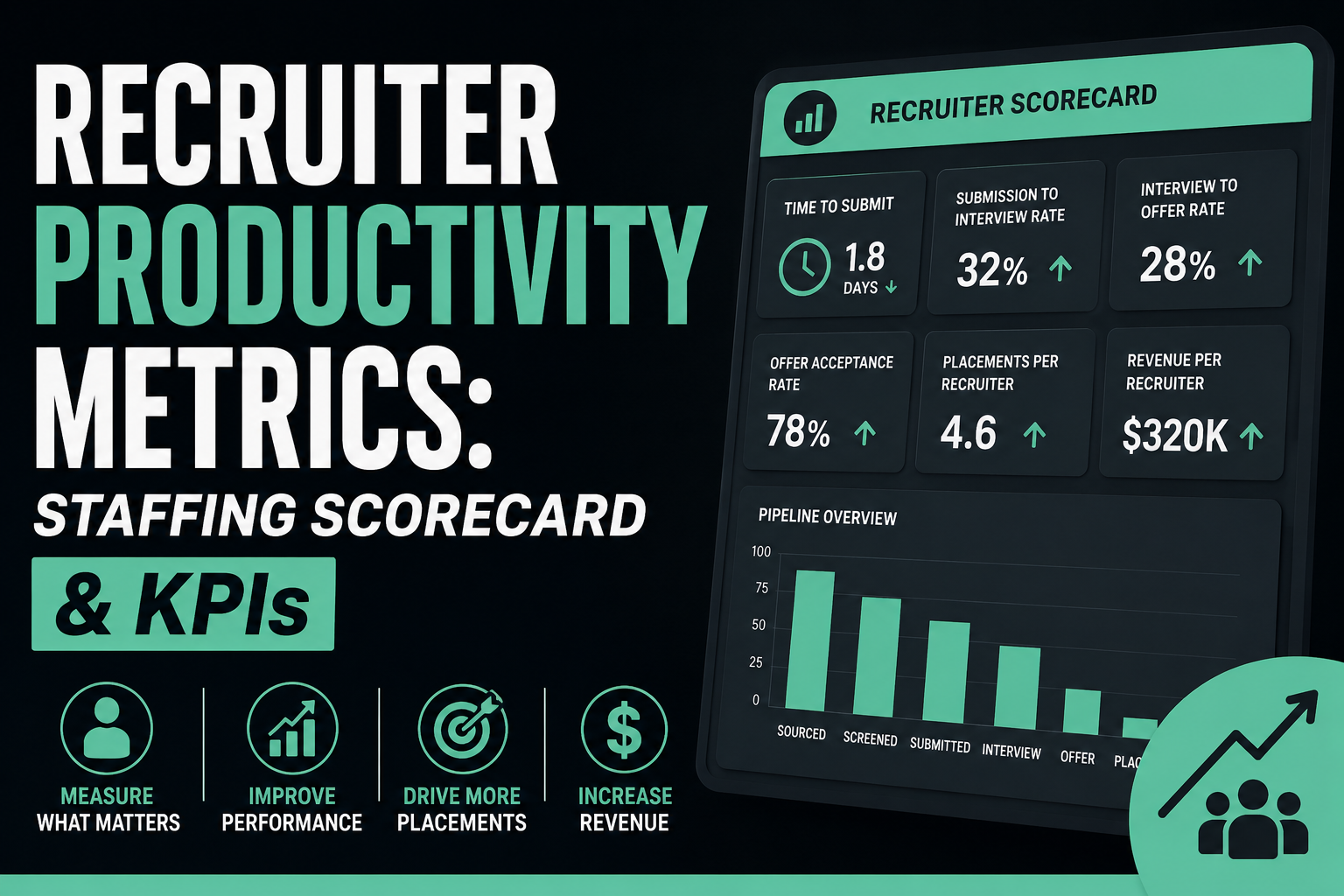
- Time-to-Submit: The elapsed time between a requirement appearing in the VMS and your agency's first qualified candidate submission.
- Submittal-to-Interview Ratio: A key metric of match precision; higher ratios indicate well-targeted candidate submissions rather than unfocused volume submittals.
- Internal Database Utilization: The percentage of candidate submittals and placements sourced directly from your existing ATS versus paid external job boards.
- Outreach Response Rate: The percentage of candidate messages that yield verified availability and rate details within 24 hours of release.
- Recruiter Requisition Capacity: The number of open contract job orders a recruiter can actively manage concurrently without sacrificing submission quality.
- MSP Vendor Tier Ranking: Supplier scorecard improvements resulting from consistent submittal speed, high interview conversion, and reduced rejection rates.
Buyer's Evaluation Framework: Selecting Staffing Automation
Agency executives evaluating AI recruiting software should test vendors against their specific production environment using this checklist:
- Identify Delivery Constraints: Determine whether your primary operational friction lies in candidate sourcing speed, database rediscovery, recruiter outreach capacity, or initial screening.
- Verify Native ATS Sync: Confirm that the solution provides true bi-directional integration with your central system (such as Bullhorn, CEIPAL, or JobDiva) to prevent duplicate data entry.
- Test Real-World Requisitions: Request live searches against complex historical job orders to evaluate how accurately the semantic engine handles domain-specific technical terminology and certifications.
- Review Data Governance and Security: Ensure candidate contact data, resumes, and client rate cards remain private, secure, and compliant with enterprise data protection standards.
- Implement Structured Desk Pilots: Test the software with a specific high-volume delivery desk over a 30 to 60-day period before executing an agency-wide deployment.
Phased 90-Day Implementation Roadmap
A structured, phased onboarding strategy helps staffing agencies adopt recruiting automation without disrupting active production desks:
| Implementation Phase | Primary Operational Objectives | Timeline |
|---|---|---|
| Phase 1: ATS Integration & Setup | Establish bi-directional ATS connections, map custom fields, and validate data synchronization. | Weeks 1–2 |
| Phase 2: Pilot Desk Deployment | Train a focused pilot team on high-volume accounts to refine outreach templates and screening workflows. | Weeks 3–6 |
| Phase 3: Baseline & Metric Review | Measure pilot time-to-submit, response rates, and submittal volume against pre-adoption historical benchmarks. | Weeks 7–8 |
| Phase 4: Full Agency Rollout | Expand platform access across all delivery desks, establish team playbooks, and monitor ongoing adoption. | Weeks 9–12 |
Staffing Verticals with High Automation Impact
While recruitment automation benefits all high-velocity recruiting teams, several sectors experience immediate operational gains:
- Information Technology & Engineering: Fast-paced contingent environments where deep technical skill taxonomies, software frameworks, and cloud certifications demand accurate semantic matching.
- Healthcare & Travel Nursing: High-turnover assignments where rapid contractor rediscovery and upfront license verification are essential.
- Finance, Accounting & Professional Services: Seasonal contractor surges requiring rapid qualification of candidates for audit, tax, and systems implementation projects.
- Light Industrial & Commercial Staffing: High-volume shifts requiring rapid multi-channel SMS outreach and automated availability confirmations.
How NinjaHire Powers Contract Staffing Agencies
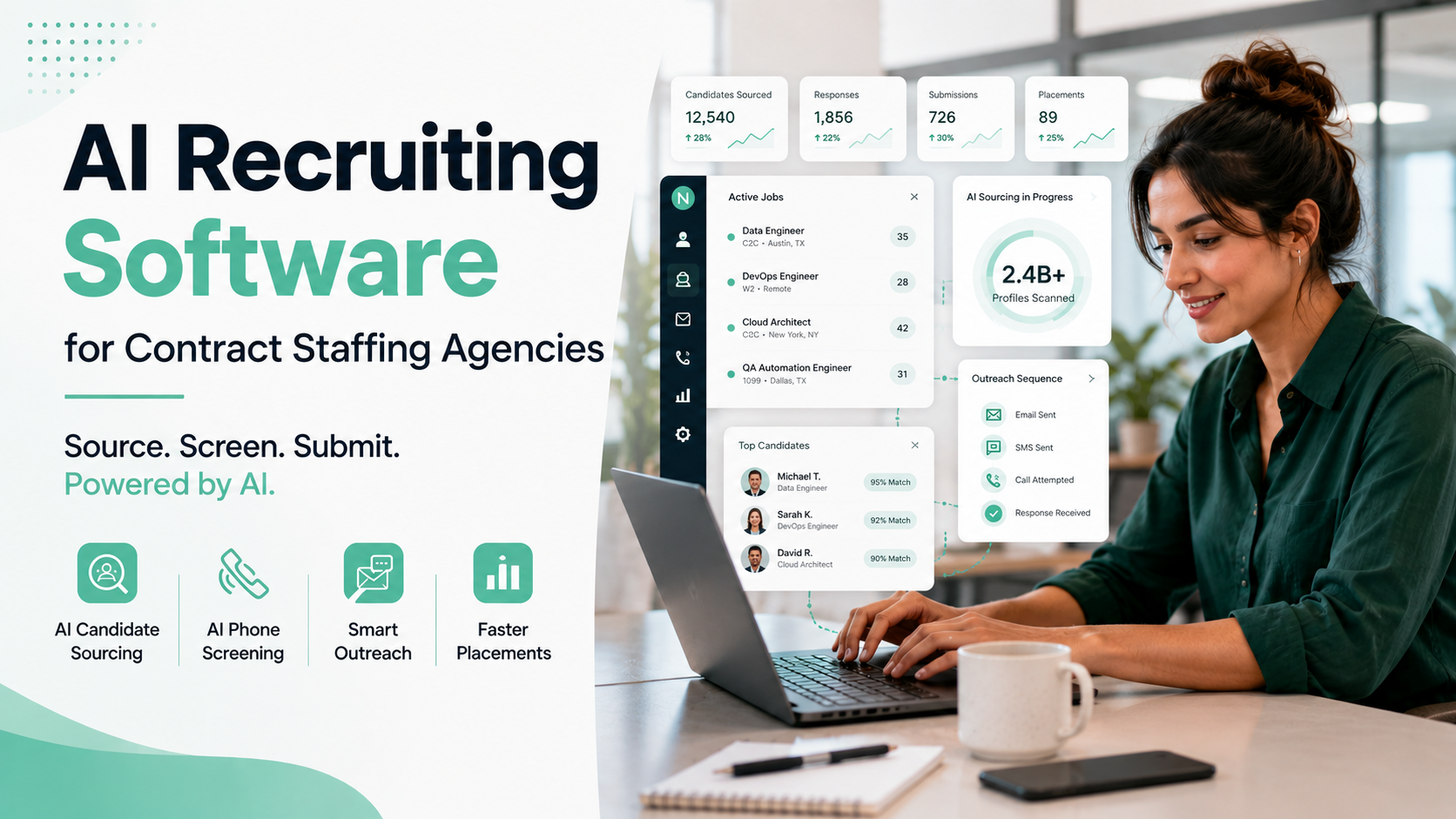
NinjaHire is an enterprise AI recruiting platform engineered specifically to solve the high-velocity delivery demands of contract staffing agencies and contingent workforce suppliers.
Designed to fit directly into established agency workflows, NinjaHire integrates with leading ATS platforms including Bullhorn, CEIPAL, and JobDiva. The platform combines intelligent candidate rediscovery, semantic resume matching, automated multi-channel candidate outreach, and conversational screening to help delivery teams identify qualified contractors and accelerate submission workflows.
By automating the repetitive sourcing and qualification stages of the contingent funnel, NinjaHire empowers staffing recruiters to focus on candidate engagement, interview preparation, and placement execution.