.png)

A recruiter arrives Monday morning to find 450 new applications for a software engineering role. Another 18,000 resumes already exist inside the ATS. The challenge isn't finding resumes. It's identifying the right people before another agency submits them first.
In high-volume contract staffing, commercial recruiting, and enterprise VMS environments, manual document review creates an immediate operational ceiling. Delivery teams spend three to four hours per requirement skimming PDFs, copying skill sets into spreadsheets, and executing rigid search filters. Meanwhile, top-tier candidates accept interviews with faster competitors, and client submission windows close.
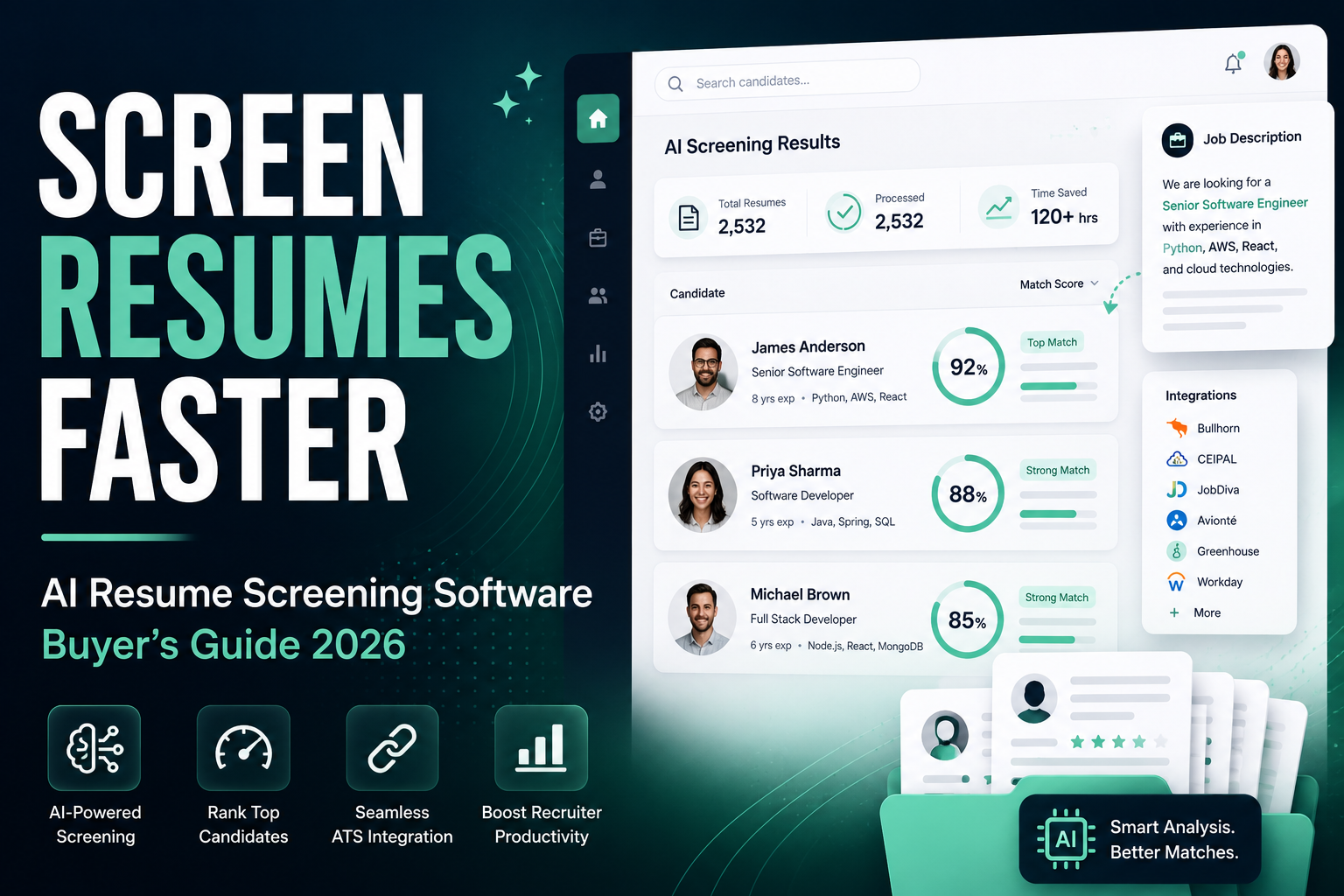
Deploying specialized AI resume screening software allows staffing firms to automate the mechanical tasks of applicant processing. Modern screening engines read resumes contextually, evaluate skill recency, rank candidate fit against client specifications, and write structured scores directly back to applicant tracking systems like Bullhorn, CEIPAL, or JobDiva in seconds.
What Is AI Resume Screening Software?
AI resume screening software is an enterprise technology that uses natural language processing (NLP) and machine learning to analyze, evaluate, and rank candidate resumes against job requisitions automatically. Unlike manual document review or legacy ATS keyword filters, it understands skill relationships, work experience recency, and career progression. For staffing agencies, this software reduces resume evaluation times from hours to seconds, surfaces historical candidates inside internal CRM databases, and accelerates client submission speeds.
Traditional resume evaluation relies on basic keyword searches or manual human skim-reading. Keyword filters penalize strong candidates who phrase experience differently, while manual review consumes valuable recruiter hours that are better spent on candidate conversations and interview preparation.
AI resume screening software parses documents beyond exact text matches. It evaluates the structure of a candidate's career, distinguishing between skills used in recent positions versus tools applied a decade ago. It compares work experience against job parameters, producing objective match ratings that guide recruiter focus.
How AI Resume Screening Works
AI resume screening platforms process documents through an automated data pipeline that converts raw files into structured candidate evaluations.
Step 1: Job Requisition Ingestion
The system ingests requirement details directly from an ATS or VMS portal. It parses mandatory qualifications, preferred skills, compensation ranges, education requirements, location constraints, and tax structures (W2, C2C, 1099), creating a dynamic evaluation rubric.
Step 2: Resume Parsing & Normalization
Unstructured resumes in PDF, Word, or plain text formats are converted into standardized digital profiles. The software extracts employment histories, company names, job titles, educational degrees, and certifications, correcting formatting errors automatically.
Step 3: Skill & Experience Analysis
Natural language processing models examine skill context. The engine determines whether a skill represents a core daily responsibility in a candidate's current role or a secondary tool used years prior, establishing true technical depth.
Step 4: Semantic Matching & Candidate Scoring
The candidate profile is evaluated against the requisition vector. The platform generates an overall fit percentage alongside sub-scores for technical proficiency, domain alignment, and experience level.
Step 5: ATS Write-Back & Recruiter Action
Match scores, parsed summaries, and candidate rankings write back to systems like Bullhorn or CEIPAL in real time. Recruiters access an ordered shortlist, allowing them to initiate contact immediately.
Manual Resume Screening vs AI Resume Screening
Transitioning from manual evaluation to automated screening replaces administrative guesswork with objective measurement. The table below illustrates core differences across key recruitment metrics.
| Performance Area | Manual Resume Review | AI Resume Screening Software |
|---|---|---|
| Processing Speed | 3 to 5 minutes per resume | Under 2 seconds per resume |
| Evaluation Consistency | Subjective; varies by recruiter fatigue and bias | Objective; applies uniform scoring criteria |
| Semantic Understanding | Limited to individual recruiter domain knowledge | High; maps equivalent titles and skill taxonomies |
| Candidate Ranking | Unranked stacks or manual spreadsheet sorting | Dynamic score-ranked talent shortlists |
| Scalability | Constrained by recruiter team size | Processes thousands of resumes concurrently |
| ATS Utilization | Low; historical profiles remain unread | High; continuously scans and ranks internal database |
| Time-to-Submit | 24 to 48 hours average turnaround | 15 to 30 minutes average turnaround |
Key Features to Look For in AI Resume Screening Software
Resume Parsing
High-accuracy document parsing converts complex layout files into clean, structured data records without losing employment context or contact information.
Semantic Resume Analysis
Semantic processing evaluates candidate experience conceptually, recognizing that an applicant listing Kubernetes, Docker, and CI/CD pipelines possesses DevOps expertise even if that specific phrase is omitted.
AI Candidate Ranking & Scoring
Dynamic scoring orders applicants objective-by-objective, delivering a prioritized pipeline to the recruiter's primary workspace.
Skill Extraction & Taxonomy Normalization
Standardizes variable job titles and tools across different industries, mapping equivalent roles into a unified taxonomy.
Resume Enrichment
Appends missing profile details by pulling public professional data to update out-of-date candidate records automatically.
Candidate Rediscovery
Scans historical resumes sitting inside your existing ATS, reactivating past talent whenever new client orders arrive.
Duplicate Detection
Identifies matching contact details and work histories across records, merging duplicate files to maintain database integrity.
ATS Integration
Provides bi-directional API connections with platforms like Bullhorn, CEIPAL, and JobDiva to sync scores, notes, and pipeline stages in real time.
Recruiter Dashboard
Delivers central operational views into active job orders, applicant match scores, team screening activity, and pipeline stage metrics.
Workflow Automation
Triggers follow-up actions automatically, such as sending qualification surveys or SMS interview invites to candidates who pass threshold scores.
Explainable Screening Decisions
Displays clear visual summaries detailing why a candidate received a high or low match score, highlighting skill overlaps and experience gaps.
Benefits for Staffing Agencies
Higher Recruiter Productivity
Automating initial document review eliminates hours of administrative manual filtering. Recruiters reallocate their daily hours toward direct candidate engagement, interview preparation, and relationship management.
Reduced Sourcing Costs
Candidate rediscovery features surface qualified talent already sitting inside your database, allowing your firm to fill requisitions using owned data rather than buying additional job board view credits.
Faster Time-to-Submit
Instant scoring enables delivery desks to present thoroughly vetted shortlists to hiring managers or VMS portals within minutes of receiving a new requisition.
Improved Placement Rates
Semantic match accuracy ensures candidates submitted align strictly with client technical environments, driving higher submittal-to-interview and interview-to-hire ratios.
ATS Integrations
AI resume screening tools must connect directly with your core system of record to prevent administrative friction and data duplication.
| Supported ATS / CRM | Integration Method | Core Data Synchronized |
|---|---|---|
| Bullhorn | Native Bi-Directional API | Parsed profile data, match scores, candidate stage updates, notes |
| CEIPAL | Native Bi-Directional API | Applicant rankings, enriched resume files, communication logs |
| JobDiva | Direct API Connector | Scorecards, submittal attachments, historical candidate updates |
| Avionté | Direct API Connector | Contract worker profiles, match ratings, assignment histories |
| Enterprise ATS (Greenhouse, Lever, Workday) | Enterprise Webhooks & API | Candidate stage progression, structured interview scores, audit trails |
The Role of Bi-Directional Synchronization
Real-time write-back ensures that any screening decision, score update, or profile enrichment made within the screening engine reflects immediately inside your main CRM. Recruiters work within their familiar ATS interface without needing to export or import CSV records manually.
Industry Use Cases
IT Staffing
Scenario: A client requires a Senior Java Developer with microservices expertise, Spring Boot, and recent AWS deployment experience.
Screening Impact: The AI engine processes 300 applicant resumes in 30 seconds, filtering out developers whose AWS experience is outdated and ranking top candidates by recent hands-on framework contributions.
Healthcare Staffing
Scenario: Urgent placement order for 20 travel ICU nurses requiring active Compact RN licenses and BLS/ACLS certifications.
Screening Impact: The system parses license details and mandatory certifications instantly, building a compliant shortlist of verified nurses ready for deployment.
Engineering Recruitment
Scenario: Direct-hire search for a Mechanical Design Engineer proficient in SolidWorks and finite element analysis (FEA).
Screening Impact: Evaluates technical CAD project descriptions across applicant work histories, separating core design engineers from draftsman-level profiles.
Manufacturing & Commercial Staffing
Scenario: High-volume intake of 150 warehouse operators for a multi-shift logistics hub.
Screening Impact: Filters high applicant volumes by shift availability, equipment certifications (forklift, OSHA), and geographic proximity within minutes.
Finance & Accounting
Scenario: Requirement for 10 Senior Financial Analysts with SEC reporting experience and CPA designations.
Screening Impact: Verifies professional credentials and ranks candidates by public accounting domain experience, bypassing generic finance applicants.
High-Volume Contract Staffing
Scenario: Managed Service Provider (MSP) requisition drop requiring rapid 1-hour candidate submittals across multiple roles.
Screening Impact: Automatically parses incoming VMS orders, matches them against internal ATS records, and alerts recruiters to top candidate matches for immediate submittal.
AI Resume Screening vs Related Technologies
1. AI Resume Screening vs Resume Parsing
| Capability | Resume Parsing | AI Resume Screening Software |
|---|---|---|
| Primary Function | Extracts text fields into database formats | Evaluates extracted data against job requisitions |
| Decision Output | Structured text record | Ranked match score with qualification rationale |
2. AI Resume Screening vs Candidate Matching
| Capability | AI Resume Screening | AI Candidate Matching |
|---|---|---|
| Primary Focus | Evaluating inbound document submissions | Mapping entire talent pools against job specs |
| Scope | Applicant fit analysis | Cross-database rediscovery & sourcing alignment |
3. AI Resume Screening vs Boolean Search
| Capability | Boolean Search Filters | AI Resume Screening Software |
|---|---|---|
| Query Structure | Manual logic strings (`AND`/`OR`) | Natural language requirement intake |
| Evaluation Depth | Literal keyword presence | Contextual skill recency & career progression |
Common Challenges and Best Practices
- Audit Data Quality: Clean duplicate records and standardize legacy candidate files before connecting screening tools.
- Maintain Human Oversight: Keep recruiters in control of final submittal decisions, using AI scores to prioritize rather than make blind rejections.
- Require Model Transparency: Select platforms providing explainable match rationale so recruiters understand score logic.
- Review Bias & Governance: Ensure algorithms evaluate candidates strictly on job-relevant skills and professional experience.
- Monitor Delivery Metrics: Track submittal turnaround times and client acceptance ratios regularly to measure operational return.
How NinjaHire Supports AI Resume Screening
NinjaHire provides an enterprise recruiting and talent intelligence platform designed specifically for staffing agencies, contract delivery teams, and high-volume recruiting operations.
By combining semantic document evaluation, candidate rediscovery, and automated voice screening with bi-directional ATS write-back, NinjaHire equips delivery teams to process requisitions and submit vetted talent in minutes.
Frequently Asked Questions
What is AI resume screening software?
AI resume screening software is an enterprise recruitment tool that uses natural language processing and machine learning to evaluate candidate resumes against job requisitions automatically, scoring and ranking applicants based on contextual fit.
How does AI resume screening differ from traditional ATS filters?
Traditional ATS filters search for exact text keywords, often ignoring qualified candidates who use title variations. AI resume screening analyzes conceptual skill usage, career progression, and experience recency to determine match fit.
Can AI resume screening search my existing ATS database?
Yes. Enterprise platforms integrate with systems like Bullhorn, CEIPAL, and JobDiva through bi-directional APIs, running background scans to rediscover past candidate profiles whenever new job requisitions are opened.
How accurate is AI resume screening software?
Modern semantic engines deliver high match accuracy by evaluating full experience context rather than word frequency, significantly reducing off-target submittals and improving client interview rates.
Does AI resume screening replace human recruiters?
No. The software automates administrative document review, allowing recruiters to focus on high-value tasks like candidate relationship management, interview preps, and placement negotiations.
Which ATS platforms support AI resume screening integrations?
Enterprise screening engines offer direct API connections for major staffing software platforms, including Bullhorn, CEIPAL, JobDiva, Avionté, Greenhouse, Lever, and Workday.
How does AI screening evaluate candidate skill recency?
Natural language processing models examine employment timelines, giving higher weight to technical tools and responsibilities practiced in recent roles compared to skills listed in earlier positions.
Can recruiters adjust AI scoring parameters manually?
Yes. Delivery managers can customize scoring rubrics by adjusting skill weightings, setting mandatory certification requirements, or altering experience thresholds for individual job orders.
How does AI resume screening reduce job board expenses?
By automatically surfacing and enriching historical candidate profiles already inside your CRM, agencies fill job orders using existing assets rather than buying external job board view credits.
Is AI resume screening effective for high-volume contract staffing?
Yes. It processes large applicant volumes concurrently, scoring candidates instantly so delivery teams can submit qualified contractors to competitive VMS portals within early submission windows.
What is explainable candidate match scoring?
Explainable match scoring provides recruiters with a transparent breakdown showing why an applicant received a specific score, detailing skill overlap percentages and experience gaps clearly.
How long does software implementation take for a staffing firm?
Most cloud-native screening platforms connect to an agency's ATS via standard API keys within 1 to 2 weeks, ensuring rapid deployment without workflow interruption.
How does duplicate detection work in resume screening systems?
The software scans contact info, work histories, and document metadata to identify duplicate candidate entries, merging fragmented CRM profiles into a unified record.
Can AI resume screening verify professional licenses and certifications?
Yes. Screening engines parse credential sections explicitly, checking for required certifications like PMP, CPA, RN licenses, or AWS credentials during document analysis.
Does AI resume screening help reduce hiring bias?
Objective scoring algorithms evaluate candidates strictly against job-relevant experience and technical skills, establishing standardized evaluations across all applicants.
What document formats do AI resume screeners support?
Modern parsing engines handle all standard resume formats, including PDF, Microsoft Word (.doc/.docx), plain text (.txt), and rich text (.rtf) files.
How does automated screening handle non-standard resume formats?
Advanced NLP parsing models analyze structural text relationships rather than strict layout coordinates, accurately extracting data from multi-column or custom visual resumes.
Can the software filter candidates by tax status (W2, C2C, 1099)?
Yes. Screening logic can incorporate tax classification and employment type requirements to ensure submitted candidates align with client engagement terms.
How does AI resume screening link with automated phone screening?
Once a resume passes initial match thresholds, the system can trigger an automated voice call or SMS invite to confirm candidate pay rates, availability, and start dates immediately.
What impact does AI resume screening have on time-to-submit?
By shrinking document review times from hours to seconds, delivery desks routinely cut total time-to-submit from 24 hours down to under 30 minutes for competitive orders.
Is candidate data kept secure in AI resume screening platforms?
Enterprise platforms maintain strict security standards, leveraging SOC 2 Type II certified infrastructure, end-to-end data encryption, and full compliance with GDPR and CCPA privacy laws.
How does AI resume screening handle industry jargon and synonyms?
Built-in domain taxonomies automatically map equivalent terms, recognizing that roles like 'Software Engineer' and 'Full Stack Developer' share fundamental technical competencies.
What metrics should operations leaders track to evaluate screening software ROI?
Key metrics include recruiter hours saved per requisition, time-to-submit acceleration, submittal-to-interview acceptance rates, and external job board credit savings.
Can AI resume screening evaluate executive-level candidates?
Yes. The software analyzes leadership scope, team size management history, budget oversight, and domain achievements to grade executive profile alignment.
Why should staffing agencies invest in dedicated screening software over basic ATS search?
Basic ATS search relies on manual query construction that misses talent. Dedicated AI screening ranks candidates contextually, delivering actionable shortlists that speed up placements.