.png)
ATS Candidate Matching: How AI Finds the Right Talent Faster 2026

July 28, 2026
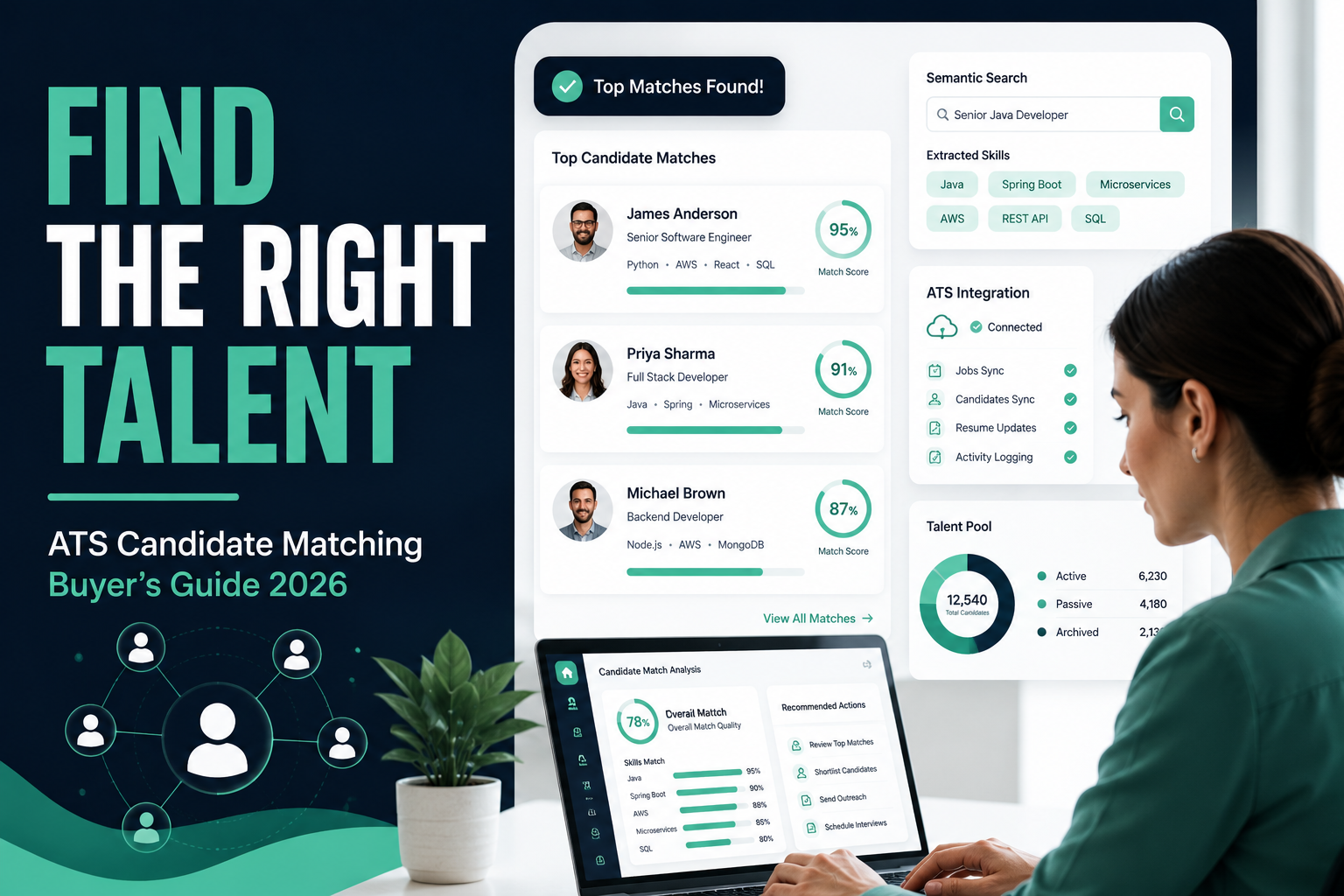
Find the Right Candidates Already in Your ATS
Learn how AI-powered ATS candidate matching helps staffing agencies rank resumes, rediscover qualified candidates, improve recruiter productivity, and reduce sourcing costs without replacing their existing ATS.
INTRODUCTION
A recruiter receives a new senior DevOps requirement with a strict 24-hour submission window. The client needs three qualified candidates submitted before noon tomorrow, or the requisition closes to competing vendors.
The staffing agency's Applicant Tracking System (ATS) contains over 250,000 resumes collected across five years of active sourcing. The talent is almost certainly already in the database. Yet, the recruiter opens LinkedIn Recruiter, builds a new search string, and pays to source candidates from scratch.
Why? Because traditional ATS search mechanisms require exact keyword matches. If a candidate lists AWS, Kubernetes, Terraform on their resume, but the recruiter searches for Cloud Engineer, CI/CD, Infrastructure as Code, the ATS returns zero relevant results. Searching the existing database feels like digging through a digital graveyard. The recruiter falls back on external job boards, driving up cost-per-hire and slowing down time-to-submit.
This operational bottleneck costs staffing agencies millions in missed placements, redundant job board subscriptions, and wasted recruiting hours. ATS candidate matching addresses this challenge directly. By applying semantic search, natural language processing, and contextual understanding to candidate databases, AI transforms static ATS repositories into active talent pipelines.
WHAT IS ATS CANDIDATE MATCHING?
ATS candidate matching is an AI-driven process that automatically analyzes job requirements and compares them against candidate profiles inside an Applicant Tracking System. Unlike legacy keyword search, AI candidate matching evaluates skill context, work history, implied competencies, and career trajectories. This enables staffing agencies to instantly rank candidates by actual job fit, rediscover hidden talent in existing databases, and reduce time-to-submit from days to minutes.
ATS candidate matching shifts recruiting from manual query building to automated requirement analysis. Traditional Applicant Tracking Systems rely on exact character matching. If a recruiter searches for Java Developer, the system looks specifically for that string. It ignores candidates who wrote J2EE Specialist, Spring Boot Engineer, or Backend Developer - Core Java.
AI ATS candidate matching evaluates the contextual relationship between words. It understands that a professional with five years of experience using PyTorch, TensorFlow, and Pandas possesses strong Python development capabilities, even if the word Python appears only once in their resume header.
How ATS Matching Operates
Traditional ATS Search
- Exact string matching
- Misses synonyms & variations
- Treats all keywords equally
- Produces unranked lists
- Ignores implied expertise
AI Candidate Matching
- Contextual skill evaluation
- Understands career progression
- Weights recent experience
- Generates match scores (1-100)
- Identifies transferable skills
Why Keyword Searches Miss Qualified Candidates
Keyword search fails in staffing environments for three structural reasons:
- Terminology Divergence: Candidates describe their work using varying industry terms, internal job titles, and specialized frameworks. A client asking for a Revenue Operations Manager might accept candidates titled Sales Operations Lead, Commercial Operations Specialist, or BizOps Manager. Keyword tools view these as distinct, unrelated terms.
- Lack of Experience Weighting: A keyword search treats a term mentioned once in a 2012 entry-level role identically to a term featured in a candidate's current principal position.
- No Contextual Parsing: Keyword systems cannot distinguish between Managed a team using Python and Python experience preferred but not required. They match on individual tokens rather than structural syntax.
Semantic search solves these issues by creating vector embeddings for candidates and job specifications. By mapping skills and experience into a multidimensional conceptual space, the software identifies candidate alignment based on actual capability rather than vocabulary choice.
HOW AI ATS CANDIDATE MATCHING WORKS
The execution of AI candidate matching inside an enterprise ATS follows a multi-stage operational workflow. Understanding this process allows recruiting operations managers to identify integration points and optimize candidate routing.
How AI Candidate Matching Works
Step 1: Job Parsing and Skill Extraction
When an account manager inputs a new job description, the AI extracts required technical skills, soft skills, required certifications, years of experience, educational requirements, and location preferences. It separates mandatory requirements from preferred qualifications.
Step 2: Database Vectorization
The matching engine evaluates candidates stored in the ATS. Resume text, past interview notes, skill tags, and updated profile details are converted into mathematical representations (vectors) that capture candidate capabilities.
Step 3: Semantic Matching
The software compares the job vector against candidate vectors across several core dimensions: Skill Proximity, Seniority Alignment, and Industry Context.
Step 4: Candidate Scoring and Ranking
The system assigns each candidate a contextual match score (1 to 100). The recruiter receives a sorted candidate shortlist with visual explanations showing why each candidate received their rating.
Step 5: Candidate Rediscovery
The system identifies past applicants, previously interviewed talent, and silver medalists who are currently sitting dormant in the ATS database.
Step 6: Recruiter Review and Validation
The recruiter reviews top-ranked candidates via a single dashboard, verifying availability, pay rate expectations, and specific client nuances.
Step 7: Automated Outreach and Engagement
Once confirmed, the recruiter initiates automated outreach sequences via email or SMS to verify availability and current interest before client submission.
TRADITIONAL ATS SEARCH VS. AI ATS CANDIDATE MATCHING
| Operational Dimension | Traditional ATS Keyword Search | AI ATS Candidate Matching |
|---|---|---|
| Search Methodology | Exact boolean/keyword matching | Contextual semantic vector matching |
| Search Input | Manual Boolean queries | Automated job description parsing |
| Synonym Recognition | None (requires explicit OR) | Automatic mapping of terms & titles |
| Candidate Ranking | Unranked or ordered by recency | Contextual fit scoring (1–100%) |
| Candidate Rediscovery | Low; past candidates remain unindexed | High; surfaces past applicants automatically |
| Recruiter Speed | 30–60 minutes per search | Seconds to generate a ranked shortlist |
| External Dependency | High reliance on LinkedIn / Job Boards | High utilization of internal database |
KEY FEATURES TO LOOK FOR IN CANDIDATE MATCHING SOFTWARE
- Semantic Resume Matching: Understands concepts rather than isolated text.
- Deep Resume Parsing: Extracts and normalizes unstructured text from PDFs/Docs.
- AI Candidate Ranking: Prioritizes candidate shortlists automatically upon job creation.
- Explainable Match Scores: Provides transparent match summaries detailing scoring rationale.
- Advanced Skill Extraction: Categorizes primary competencies, tools, and domain knowledge.
- Candidate Rediscovery: Automatically pulls dormant, past qualified candidates into new pipelines.
- Full ATS Database Search: Indexes resume attachments, recruiter notes, and interview feedback.
- Automated Duplicate Detection: Consolidates duplicate profiles seamlessly.
- Recruiter Control Dashboards: Allows recruiters to manually lock/weight specific parameters.
- Recruitment Workflow Automation: Triggers actions based on high score thresholds.
- Bi-Directional ATS Synchronization: Real-time 2-way sync with core ATS platforms.
Candidate Match Summary
+ Positive Match Factors
- ✓6 years React.js / TypeScript experience (+25%)
- ✓AWS Certified Solutions Architect (+15%)
- ✓Previous employment at enterprise SaaS companies (+20%)
! Gap Analysis / Missing Criteria
- −No direct experience with GraphQL listed (-7%)
- −Target rate ($85/hr) is slightly above client budget ($80/hr)
BUSINESS BENEFITS FOR STAFFING AGENCIES
| Metric | Traditional ATS | With AI Matching |
|---|---|---|
| Average Time-to-Submit | 48–72 Hours | 2–4 Hours |
| Internal Database Reuse | 8–12% | 45–65% |
| Recruiter Sourcing Time | 15 Hrs/Week | 3 Hrs/Week |
| Monthly Job Board Spend | High ($$$$) | Reduced ($$) |
| Submittal-to-Interview Ratio | 3:1 | 1.5:1 |
- Increased Recruiter Productivity: Eliminates tedious string building.
- Accelerated Time-to-Submit: Wins placements in tight VMS/MSP windows.
- Maximized ATS ROI: Activates the unused 85%+ of internal candidate databases.
- Direct Cost Reduction: Decreases expensive external job board dependencies.
- Improved Placement Quality: Higher interview acceptance and retention rates.
ATS INTEGRATIONS & ARCHITECTURE
Supported platforms via deep REST API & bi-directional sync include Bullhorn, CEIPAL, JobDiva, Avionté, Recruit CRM, Vincere, Greenhouse, Lever, Workday, and SAP SuccessFactors.
INDUSTRY USE CASES
- IT & Technology Staffing: Maps complex developer toolchains instantly.
- Healthcare & Clinical Staffing: Filters by state licenses, certifications (BLS/ACLS), and shifts.
- High-Volume Commercial Staffing: Quickly matches location, commute patterns, and shift preferences.
- Executive Search: Analyzes qualitative leadership markers, revenue scope, and growth trajectories.
COMPARISON TABLES
ATS Candidate Matching vs. Boolean Search
| Dimension | Boolean Search | ATS Candidate Matching |
|---|---|---|
| User Input | Complex syntax strings | Job description paste |
| Error Rate | High (broken syntax) | Low (dynamic syntax) |
| Synonyms | Manual entry required | Automatic mapping |
ATS Candidate Matching vs. Resume Parsing
| Dimension | Resume Parsing | ATS Candidate Matching |
|---|---|---|
| Function | Extracts text into structured fields | Scores candidate fit against jobs |
| Data Output | Name, Contact, Education fields | Ranked match score & gap analysis |
COMMON IMPLEMENTATION CHALLENGES & BEST PRACTICES
- Data Hygiene: Implement auto-deduplication and field normalization upon rollout.
- Recruiter Adoption: Conduct blind A/B testing comparing manual vs. AI sourcing speed.
- Mitigation of Bias: Disable PII parameters (age, gender, address) in match calculations.
- System Integration: Ensure insights are embedded directly within native ATS UI views.
HOW NINJAHIRE ENHANCES ATS CANDIDATE MATCHING
NinjaHire provides an AI-powered talent intelligence layer engineered specifically for staffing agencies, executive search firms, and enterprise recruitment teams. Rather than forcing agencies to replace their existing Applicant Tracking Systems, NinjaHire integrates directly over systems like Bullhorn, CEIPAL, JobDiva, Avionté, and Recruit CRM to unlock database value.
- Instant Semantic Matching
- Automated Candidate Rediscovery
- Transparent Match Breakdown
- AI Phone Screening Integration
- Native ATS Connectivity
IMPLEMENTATION CHECKLIST FOR RECRUITING OPERATIONS
- Audit current ATS database record volume and duplicate profile ratios.
- Measure baseline time-to-submit, candidate sourcing costs, and job board spend.
- Verify native, bi-directional API support for your primary ATS/CRM platform.
- Confirm search indexing encompasses resume attachments, notes, and custom profile fields.
- Conduct a 30-day pilot with a dedicated team of recruiters across active requisitions.
FREQUENTLY ASKED QUESTIONS


Subscribe to our newsletter
Want to stay up to date with news and updates about our product? Subscribe.
© Copyright 2026