.png)
Recruitment Analytics Software for Staffing Agencies

August 6, 2026
Staffing Operations · Executive Guide
Most recruitment analytics tools tell you what already happened. This guide introduces Recruiting Intelligence, the layer above analytics that explains why, forecasts what comes next, and tells leaders what to do about it.
Executive Summary
Recruitment analytics answers descriptive questions: how many candidates were submitted, how long did a requisition stay open, which recruiter closed the most placements last quarter. These are necessary numbers, but they are backward-looking. They describe outcomes without explaining the conditions that produced them.
Recruiting Intelligence is the discipline of layering business context and AI interpretation on top of that raw analytics data, so that leaders understand why a metric moved, what is statistically likely to happen next in the pipeline, and what action is worth taking now. This guide walks through that shift chapter by chapter, from foundational metrics to a proprietary maturity model staffing leaders can use to assess where their organization stands today.
Chapter 1: What Is Recruitment Analytics Software?
Simple definition: Software that turns raw hiring activity into numbers leaders can read at a glance.
Executive definition: A reporting layer that converts recruiter and pipeline activity into performance indicators tied to revenue, delivery speed, and client satisfaction, supporting resourcing and forecasting decisions.
Technical definition: A system that aggregates structured data from ATS, CRM, VMS, and communication tools, applies calculations against defined metric definitions, and renders the results through dashboards, scheduled reports, or query interfaces.
Evolution of the category
Early staffing agencies relied on manually compiled spreadsheets pulled from ATS exports, often a week or more out of date by the time leadership reviewed them. As ATS and CRM platforms matured, native reporting modules emerged, followed by dedicated business intelligence layers that could blend data across systems. The current frontier applies AI not just to visualize this data, but to interpret it, which is where Recruiting Intelligence begins.
Chapter 2: Why Staffing Agencies Need Recruiting Analytics
Common operational problems
- Pipeline bottlenecks discovered only after a requisition is overdue
- Wide, unexplained variance between individual recruiter results
- Hours spent compiling manual client and internal reports
- Limited visibility into which sources actually convert to placements
Business consequences
- Revenue leakage from slow-moving or stalled requisitions
- Forecasting built on gut feel rather than pipeline data
- Delayed decisions on reallocating recruiter capacity
- Client dissatisfaction from inconsistent delivery timelines
Chapter 3: The Recruiting Intelligence Framework™
Most recruiting technology stops at the analytics layer: a chart showing that time-to-fill increased. Recruiting Intelligence continues past that point, asking why it increased, what it predicts about the next thirty days, and what a recruiter or executive should do in response.
Layers 1–3: Foundation
Data collection captures raw activity from ATS, CRM, and VMS systems. Analytics converts that activity into standard metrics. Business context attaches those metrics to client accounts, revenue targets, and staffing plans, so a number means something beyond itself.
Layers 4–9: Intelligence
AI interpretation identifies patterns across historical placements. Predictions forecast pipeline and revenue outcomes. Recommendations translate predictions into specific next actions, which recruiters execute and executives use to make resourcing and account decisions that shape business outcomes.
Chapter 4: Essential Recruiting Metrics
| Metric | Definition | Executive action it informs |
|---|---|---|
| Time to Fill | Days from requisition open to accepted offer | Client SLA management and staffing capacity planning |
| Time to Submit | Days from requisition open to first candidate submittal | Sourcing responsiveness by recruiter or team |
| Submittal-to-Interview | Share of submittals that reach an interview | Screening quality and candidate-role fit |
| Interview-to-Offer | Share of interviews that result in an offer | Interview preparation and client alignment |
| Offer Acceptance Rate | Share of offers accepted by candidates | Compensation competitiveness and candidate experience |
| Placement Rate | Share of requisitions successfully filled | Overall delivery capability by client or vertical |
| Revenue per Recruiter | Placement revenue attributed to an individual recruiter | Capacity planning and compensation review |
| Revenue per Client | Total placement revenue by client account | Account prioritization and relationship investment |
| Pipeline Velocity | Speed at which candidates move through stages | Process bottleneck identification |
| Candidate Response Rate | Share of outreach that receives a reply | Messaging and channel effectiveness |
| Source Performance | Placement conversion rate by sourcing channel | Sourcing budget allocation |
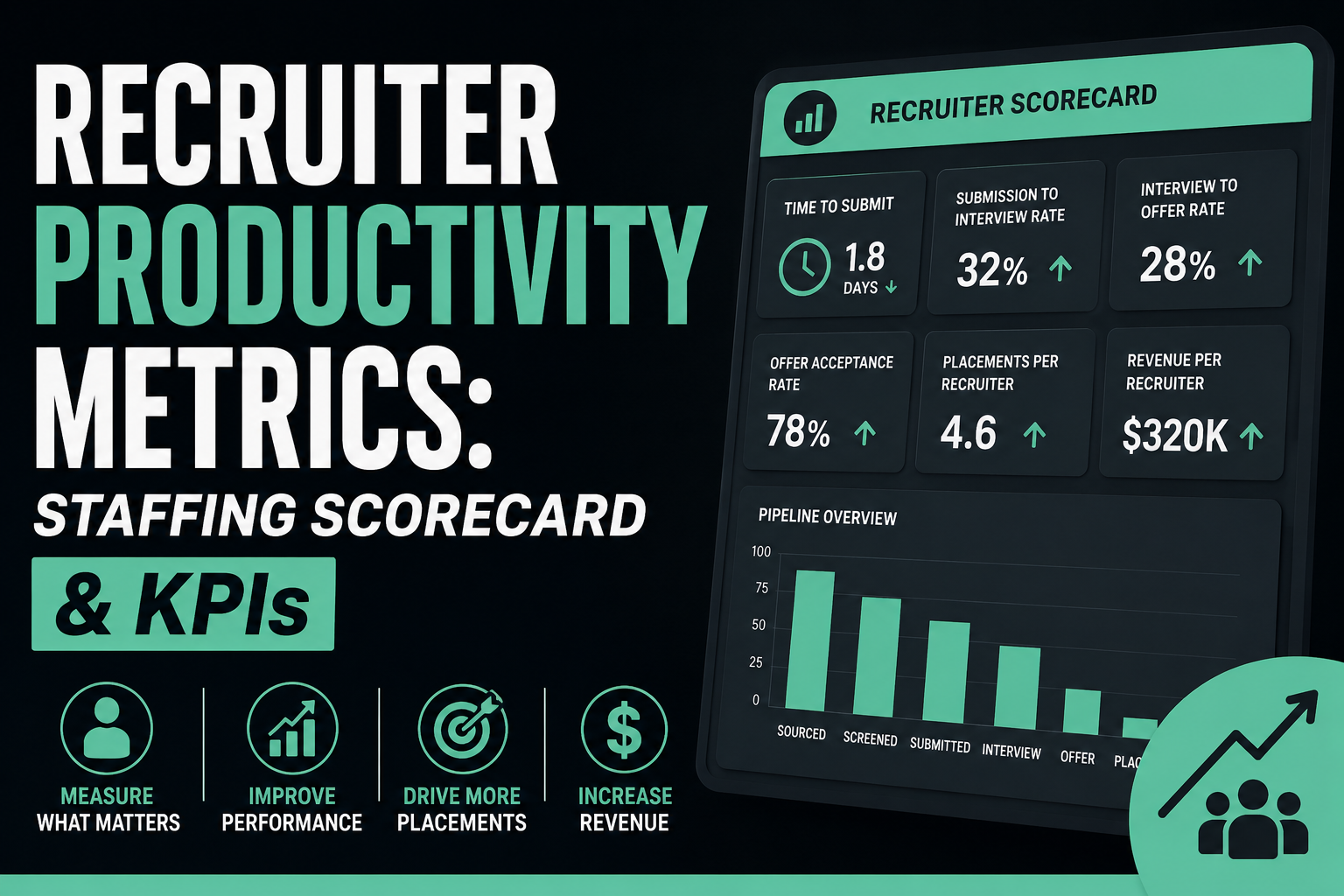
| Recruiter Productivity | Activity and outcomes per recruiter over time | Coaching priorities and workload balance |
| Pipeline Health | Volume and quality of active candidates per requisition | Early warning for at-risk requisitions |
| Quality of Hire | Post-placement performance and retention | Screening process validation |
| Client Satisfaction | Client-reported delivery and communication quality | Account health and renewal risk |
| Cost per Placement | Total cost divided by completed placements | Sourcing efficiency and margin management |
Benchmark values vary meaningfully by industry, role seniority, and geography, so agencies should establish internal baselines before comparing against external benchmarks.
Chapter 5: AI Recruitment Analytics
Core capabilities
- Predictive analytics for fill likelihood and time-to-fill
- Placement and revenue forecasting by team or account
- Recruiter-level recommendations on prioritization
- Risk alerts for stalled or at-risk requisitions
- Candidate rediscovery from historical pipeline data
Governance considerations
- Executive AI copilots should surface reasoning, not just conclusions
- Human-in-the-loop review at decision points affecting candidates
- Documented model logic for audit and compliance review
- Ongoing bias testing on predictive and ranking models
Can AI predict hiring success? AI can estimate the probability of a successful, timely placement based on patterns in historical data, but it functions as a decision-support signal rather than a guarantee, and should be weighed alongside recruiter judgment and client-specific context.
Chapter 6: Executive Dashboards by Role
Executive
Users: Owners, CEOs
KPIs: Revenue, placement rate, pipeline health
Decisions: Resourcing, growth planning
Frequency: Weekly
Recruiter
Users: Individual recruiters
KPIs: Submittals, interviews, activity
Decisions: Daily prioritization
Frequency: Daily
Sales
Users: Business development
KPIs: New client wins, requisition volume
Decisions: Account prioritization
Frequency: Weekly
Delivery
Users: Delivery managers
KPIs: Time-to-fill, pipeline velocity
Decisions: Resource reallocation
Frequency: Daily to weekly
Finance
Users: Finance leaders
KPIs: Cost per placement, margin
Decisions: Budget and pricing review
Frequency: Monthly
Client Success
Users: Account managers
KPIs: Client satisfaction, SLA adherence
Decisions: Renewal and escalation planning
Frequency: Weekly
Chapter 7: Recruitment Reporting vs Business Intelligence vs Recruiting Intelligence
| Layer | Question answered | Business value |
|---|---|---|
| Recruitment Reporting | What happened last period? | Historical record-keeping |
| Analytics | What are the patterns in what happened? | Trend visibility |
| Business Intelligence | How do metrics relate across the business? | Cross-functional visibility |
| Predictive Intelligence | What is likely to happen next? | Early risk detection |
| Recruiting Intelligence | What should we do about it? | Direct executive and recruiter action |
Chapter 8: AI Recruiting Analytics Software
Emerging capabilities
- Knowledge graphs connecting candidates, clients, and outcomes
- Natural language analytics queries in place of manual filtering
- Executive copilots summarizing pipeline risk on request
- Autonomous reporting that drafts weekly summaries for review
What stays human
- Final judgment on candidate and client decisions
- Interpretation of nuanced account relationships
- Oversight of AI-generated recommendations before action
- Accountability for compliance and fairness outcomes
Modern recruiting platforms such as NinjaHire illustrate this direction, applying AI interpretation to pipeline and placement data while keeping recruiters and executives in the loop for the decisions that follow.
Chapter 9: Choosing Recruitment Analytics Software
Executive buying checklist
- Does it integrate natively with your ATS, CRM, and VMS systems?
- Can it ingest LinkedIn and job board source data for attribution?
- What security certifications and data controls are in place?
- How customizable are metric definitions and dashboard views?
- Does it scale from a single office to a multi-branch operation?
- What reporting formats does it support for client-facing use?
- How mature is the AI layer, and is its reasoning explainable?
- What does pricing look like as recruiter headcount grows?
- What support model exists during and after implementation?
- What ROI evidence exists from comparable staffing agencies?
The Recruiting Intelligence Maturity Model™
Level 1, Manual Reporting
Technology: Spreadsheets and manual exports. Decision quality: Reactive, delayed by days or weeks. Outcome: Leaders discover problems after they affect delivery.
Level 2, Dashboard Analytics
Technology: Native ATS or CRM dashboards. Decision quality: Faster visibility, still descriptive. Outcome: Leaders see what happened in near real time.
Level 3, Diagnostic Analytics
Technology: Cross-system business intelligence layer. Decision quality: Leaders can trace why a metric moved. Outcome: Root-cause visibility across recruiters and accounts.
Level 4, Predictive Recruiting Analytics
Technology: Forecasting models on pipeline and revenue data. Decision quality: Leaders anticipate risk before it materializes. Outcome: Proactive resourcing and account management.
Level 5, AI-Powered Recruiting Intelligence
Technology: Agentic AI, natural language analytics, executive copilots. Decision quality: Recommended actions delivered alongside predictions. Outcome: Recruiter and executive decisions guided continuously, with human oversight retained.
Chapter 10: The Future of Recruiting Intelligence
Staffing agencies moving toward AI-first operations are likely to see reporting shift from a scheduled, manual activity to a continuously updated, queryable layer that recruiters and executives interact with in natural language. Decision intelligence, systems that not only predict outcomes but weigh trade-offs across competing priorities, represents a plausible next step, though its maturity and governance requirements are still developing across the industry. Agencies that build strong data foundations today, at Levels 2 and 3 of the maturity model, will be better positioned to adopt these capabilities as they mature.
Frequently Asked Questions
What is recruitment analytics software?
Software that collects hiring and pipeline data and converts it into reports and dashboards covering metrics like time-to-fill and placement rate.
Why do staffing agencies need recruiting analytics?
To gain visibility into pipeline bottlenecks, recruiter performance, and revenue trends that are otherwise invisible until they affect delivery.
What metrics should staffing agencies track?
Core metrics include time-to-fill, submittal-to-interview ratio, placement rate, revenue per recruiter, and pipeline velocity.
What KPIs matter most for staffing agencies?
Time-to-fill, placement rate, and revenue per recruiter are typically the highest-priority KPIs for staffing leadership.
How does AI improve recruiting analytics?
AI identifies patterns in historical data to forecast outcomes and recommend actions, rather than only reporting past activity.
What is predictive recruiting analytics?
Predictive recruiting analytics forecasts outcomes such as fill probability or time-to-fill based on historical pipeline patterns.
What is recruiter productivity?
Recruiter productivity measures the activity and outcomes an individual recruiter generates over a given period.
What is recruiting intelligence?
Recruiting Intelligence combines analytics with business context and AI interpretation to explain why outcomes occurred and recommend next actions.
How do recruiting dashboards work?
Dashboards aggregate data from ATS, CRM, and other systems and display it visually against defined metrics for a specific audience.
What should executives see in a recruiting dashboard?
Executives typically need revenue, placement rate, and pipeline health summarized at a glance, updated weekly.
How does analytics improve placements?
Analytics identifies where candidates drop out of the pipeline, allowing recruiters to address specific bottlenecks earlier.
How does analytics reduce time-to-fill?
By surfacing stalled requisitions and source performance data, analytics helps recruiters prioritize the highest-converting activities.
Can AI predict hiring success?
AI can estimate the likelihood of a successful placement based on historical patterns, functioning as a decision-support signal rather than a guarantee.
What is recruitment forecasting?
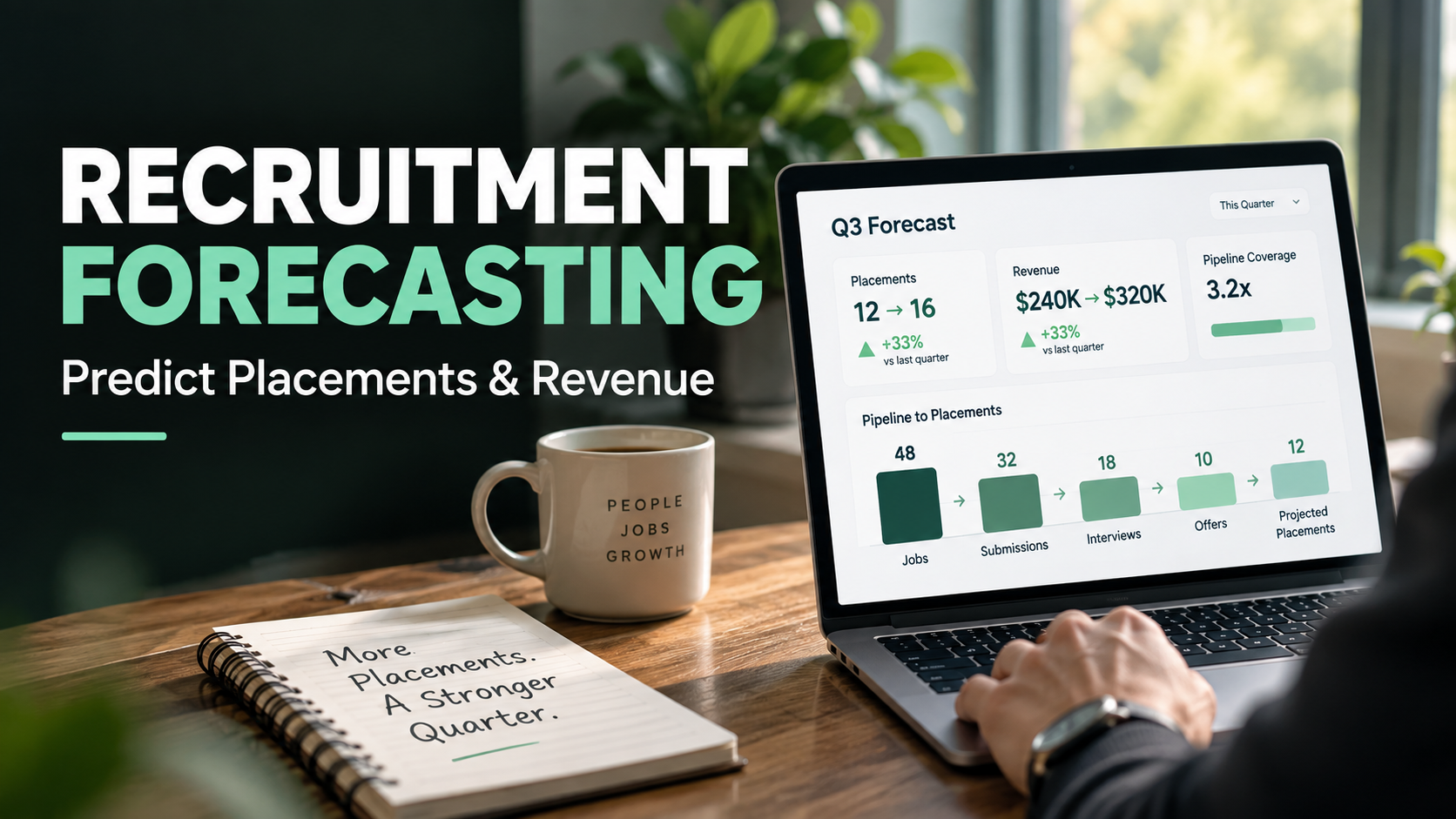
Recruitment forecasting projects future placement volume and revenue based on current pipeline and historical conversion rates.
How do staffing agencies measure recruiter performance?
Through metrics like submittals, interview conversion, placement rate, and revenue generated per recruiter.
How do AI recruiting analytics platforms work?
They ingest data from recruiting systems, apply machine learning models to detect patterns, and present forecasts and recommendations to users.
What is the Recruiting Intelligence Framework?
A nine-layer model describing how raw recruiting data progresses through analytics, AI interpretation, and prediction into recommended executive action.
What is the Recruiting Intelligence Maturity Model?
A five-level model describing an agency's progression from manual reporting to fully AI-powered recruiting intelligence.
What is pipeline analytics?
Pipeline analytics tracks candidate movement and volume through each stage of the recruiting process.
What is placement analytics?
Placement analytics measures completed hires against requisitions, revenue, and time-to-fill benchmarks.
What is an executive dashboard?
A summarized view of key recruiting metrics designed for leadership decision-making rather than day-to-day recruiter use.
What is business intelligence in recruiting?
Business intelligence connects recruiting data with broader business systems to reveal cross-functional patterns and relationships.
What is decision intelligence?
Decision intelligence combines predictions with business trade-offs to recommend a specific course of action, beyond forecasting alone.
What is an AI copilot in recruiting?
An AI copilot is an assistant that answers natural language questions about recruiting data and suggests next actions to a recruiter or executive.
What is a knowledge graph in recruiting analytics?
A knowledge graph connects candidates, clients, requisitions, and outcomes as linked data points, enabling more contextual analysis.
What is agentic AI in recruiting analytics?
Agentic AI refers to systems that can autonomously execute multi-step analytical or reporting tasks within human-defined guardrails.
What does human-in-the-loop mean in recruiting analytics?
It means a human reviews and approves AI-generated recommendations before they influence consequential decisions.
How much does recruitment analytics software cost?
Pricing varies by vendor and typically scales with recruiter seats and data volume; buyers should request current vendor pricing directly.
How long does implementation take?
Implementation timelines vary by integration complexity, ranging from a few weeks for basic dashboards to several months for full AI-driven deployments.
What is the ROI of recruiting analytics software?
ROI is typically measured through reduced time-to-fill, improved placement rate, and hours saved on manual reporting, though results vary by agency.
Does recruitment analytics software integrate with ATS and CRM?
Most modern platforms integrate with common ATS, CRM, and VMS systems, though integration depth varies by vendor.
What security considerations apply to recruiting analytics platforms?
Buyers should evaluate data encryption, access controls, and compliance certifications relevant to their industry and geography.
How is recruiting analytics different for staffing agencies versus corporate TA teams?
Staffing agencies typically weight revenue and client-facing metrics more heavily, while corporate teams emphasize quality of hire and retention.
Can small staffing agencies benefit from recruiting analytics?
Yes, even basic dashboard-level analytics can reveal bottlenecks that are difficult to see through manual reporting alone.
What is revenue intelligence in staffing?
Revenue intelligence connects recruiting pipeline data directly to revenue outcomes, helping leaders forecast and manage margin.
What is source performance tracking?
Source performance tracking measures which sourcing channels generate the highest-converting candidates and placements.
How often should recruiting dashboards be updated?
Update frequency should match how the data is used, daily for recruiter activity, weekly for executive summaries, monthly for finance.
What is quality of hire?
Quality of hire measures how a placed candidate performs and remains in role after placement, validating the screening process.
What common misconceptions exist about recruiting analytics?
A common misconception is that more dashboards equal better decisions; without business context and clear ownership, additional metrics can add noise rather than clarity.
How should staffing agencies start building recruiting intelligence capability?
Agencies should first establish reliable data collection and consistent metric definitions before layering predictive or AI capabilities on top.