.png)

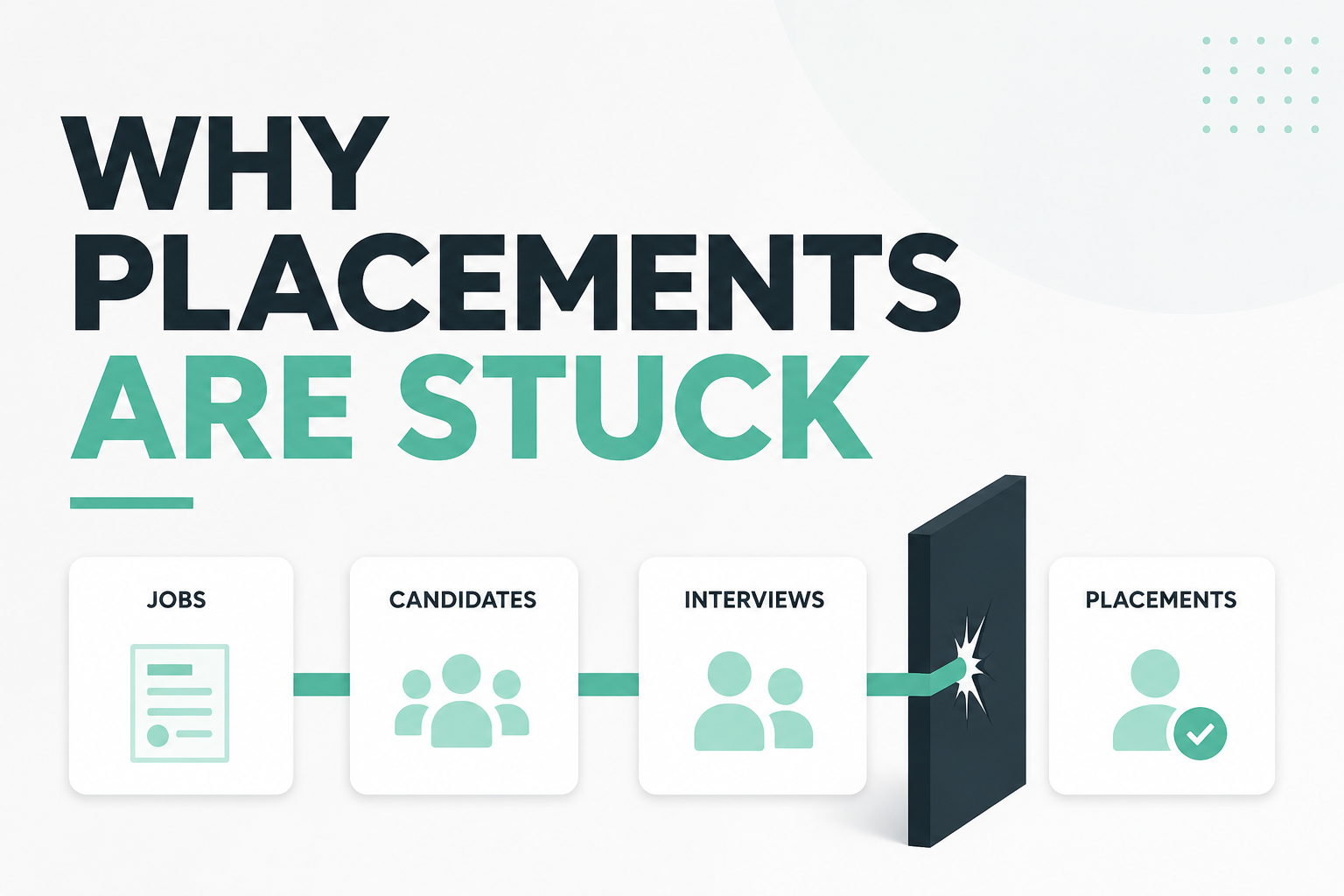
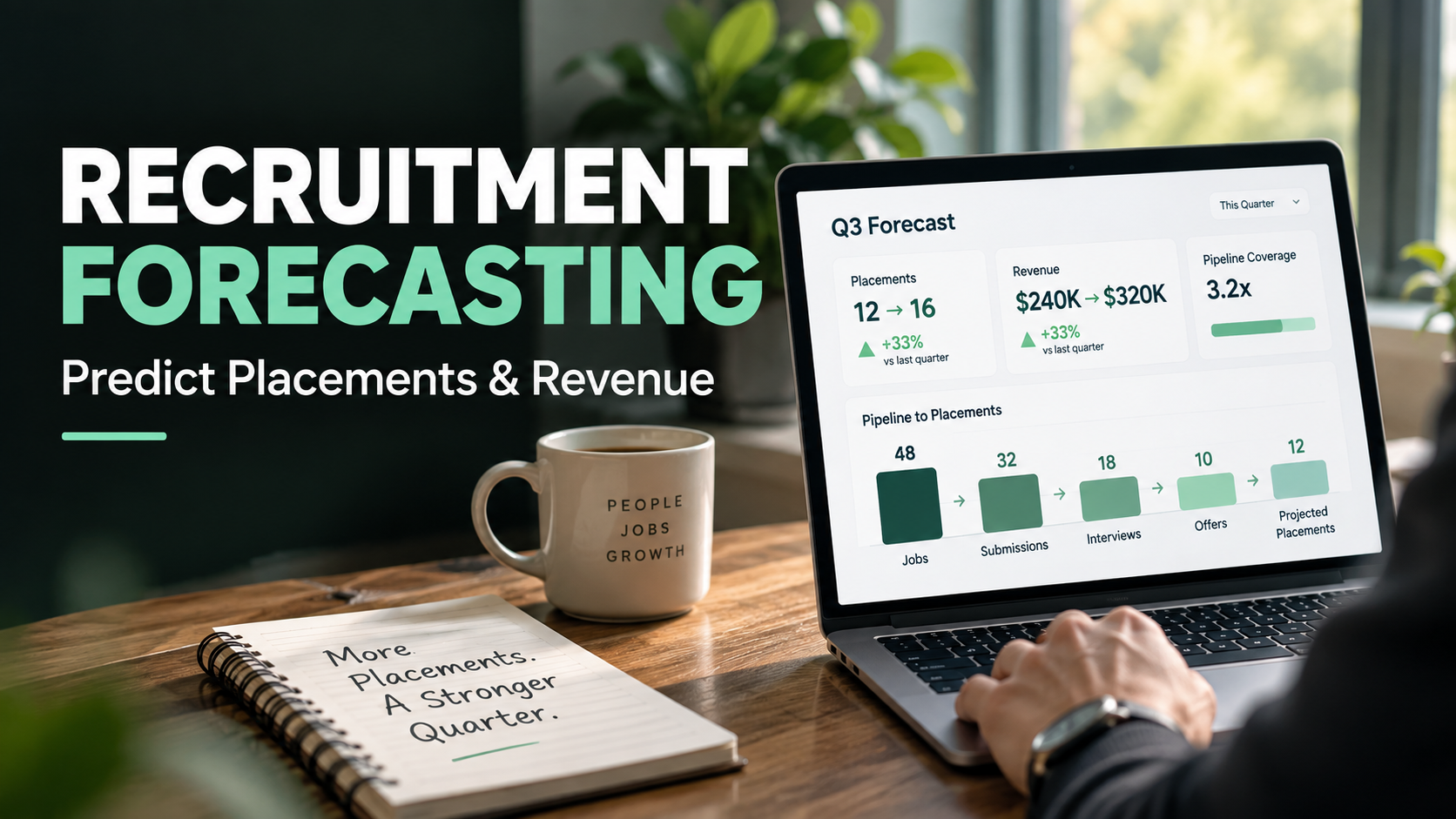
Your recruiters may be working harder than they ever have, and your placement numbers can still stay flat.
That's the part that doesn't make sense to most staffing owners at first. More sourcing. More calls. More submissions. Same number of placements at the end of the month. The instinct is to look at the recruiter — maybe they're not working hard enough, maybe they need more coaching, maybe the desk needs another headcount. Sometimes that's true. More often, the activity is real and the output still isn't moving, which means the problem isn't effort. It's somewhere in the workflow between the effort and the outcome.
A recruiter can source a hundred candidates, send eighty messages, submit twenty profiles and run ten screening calls in a week and still walk away with one placement, or none. If sourcing volume, submission count and message activity are all up and placements aren't, the issue usually isn't that people are working less. It's that the funnel connecting activity to revenue is leaking somewhere, and nobody has looked closely enough to find where.
What Is Staffing Agency Productivity?
Staffing agency productivity is the amount of commercially valuable output a recruiting team generates relative to its capacity — not the amount of activity it performs. Depending on the staffing model, valuable output can mean placements, revenue, gross profit, qualified submissions, fill rate, client retention or contractor redeployment.
There's no single number that defines good staffing agency productivity across the industry, and treating one benchmark as universal usually causes more harm than the ambiguity it's meant to solve. A healthcare staffing desk running contract placements looks nothing like an executive search desk running six-figure direct-hire searches. Productivity depends on the staffing model, the niche, the role type, the market, how qualified the job orders actually are, and what a given recruiter is responsible for beyond just filling roles. A recruiter running fifteen open job orders across three clients has a different productivity profile than one running two exclusive searches for a single account, even if the second one closes more per placement.
Why More Recruiter Activity Doesn't Always Mean More Placements
Activity measures effort. Outcomes measure business impact. They're related, but they're not the same thing, and conflating them is where a lot of staffing management goes wrong.
| Activity | What it tells you | What it doesn't tell you |
|---|---|---|
| Candidates sourced | Sourcing volume | Candidate quality |
| Calls made | Outreach activity | Candidate engagement |
| Emails sent | Communication volume | Response rate |
| Profiles submitted | Submission volume | Client acceptance |
| Interviews | Pipeline movement | Offer likelihood |
| Placements | Business outcome | Why the funnel succeeded |
A busy desk can still be an inefficient desk. High call volume with low response rates isn't productivity — it's activity that hasn't found traction yet. The same is true further down the funnel: a recruiter who submits twenty profiles a week but gets two interviews is producing a lot of motion and very little conversion, and the fix for that is rarely "submit more."
The Staffing Agency Productivity Funnel
The clearest way to diagnose where things are actually breaking is to stop looking at any single metric in isolation and look at the full path a job order travels before it turns into revenue.
Job Order
What's measured: number and quality of open requisitions. Why it matters: a weak or vague job order limits everything downstream, no matter how good the recruiter is. Warning signs: job orders with unclear requirements, unrealistic budgets, or clients who are slow to give feedback. What to investigate: whether recruiters are working job orders that were never well-defined in the first place.
Sourcing
What's measured: candidates identified per job order. Why it matters: this is the top of the funnel, but volume alone doesn't predict placements. Warning signs: high sourcing counts with low qualification rates. What to investigate: whether sourcing channels are actually matched to the role, or whether recruiters are casting a wide net because targeted sourcing takes too long.
Qualification
What's measured: candidates who meet the actual requirements after review. Why it matters: this is usually where the funnel first narrows sharply, and it's often under-examined. Warning signs: a large gap between candidates sourced and candidates qualified. What to investigate: whether screening criteria are consistent, or whether recruiters are qualifying based on incomplete job information.
Submission
What's measured: qualified candidates actually sent to the client. Why it matters: submission is where recruiter judgment meets client expectations directly. Warning signs: submissions going out that don't convert to interviews at a reasonable rate. What to investigate: submission quality, resume presentation, and whether the recruiter understands what the client actually responds to.
Interview
What's measured: submissions that convert to a client conversation. Why it matters: this is the strongest signal of whether sourcing and qualification were actually accurate. Warning signs: strong submission volume with a low interview rate. What to investigate: whether the client is getting timely feedback, and whether the matching logic upstream is actually aligned with what hiring managers want.
Offer
What's measured: interviews that produce an offer. Why it matters: a low offer rate after strong interviews often points to a mismatch that wasn't caught earlier. Warning signs: candidates interviewing well but not receiving offers. What to investigate: compensation alignment, client indecision, or a gap between what was screened for and what the client actually evaluates.
Placement
What's measured: offers that convert into a start. Why it matters: this is the final and most fragile step — everything upstream can go right and still fail here. Warning signs: offers declined or candidates going dark after acceptance. What to investigate: candidate engagement through the final stretch, and whether competing offers were a factor recruiters could have anticipated.
Revenue
What's measured: financial outcome of the placement. Why it matters: a placement isn't automatically a good outcome if the margin doesn't support it. Warning signs: placement counts rising while gross profit per placement falls. What to investigate: job order economics, not just fill rate.
Find Your Placement Bottleneck
Ninjahire Placement Bottleneck Calculator — this is a practical diagnostic tool, not an industry benchmark. Enter your numbers for a period (a week, a month, a quarter) to see where your funnel is converting the least.
7 Staffing Agency Productivity Metrics That Actually Matter
These are organized by what each category actually tells a staffing leader, not just as a flat list to track.
Pipeline
Qualified candidates per job, submissions per job, and active job orders show whether recruiters have enough of the right raw material to work with in the first place.
Conversion
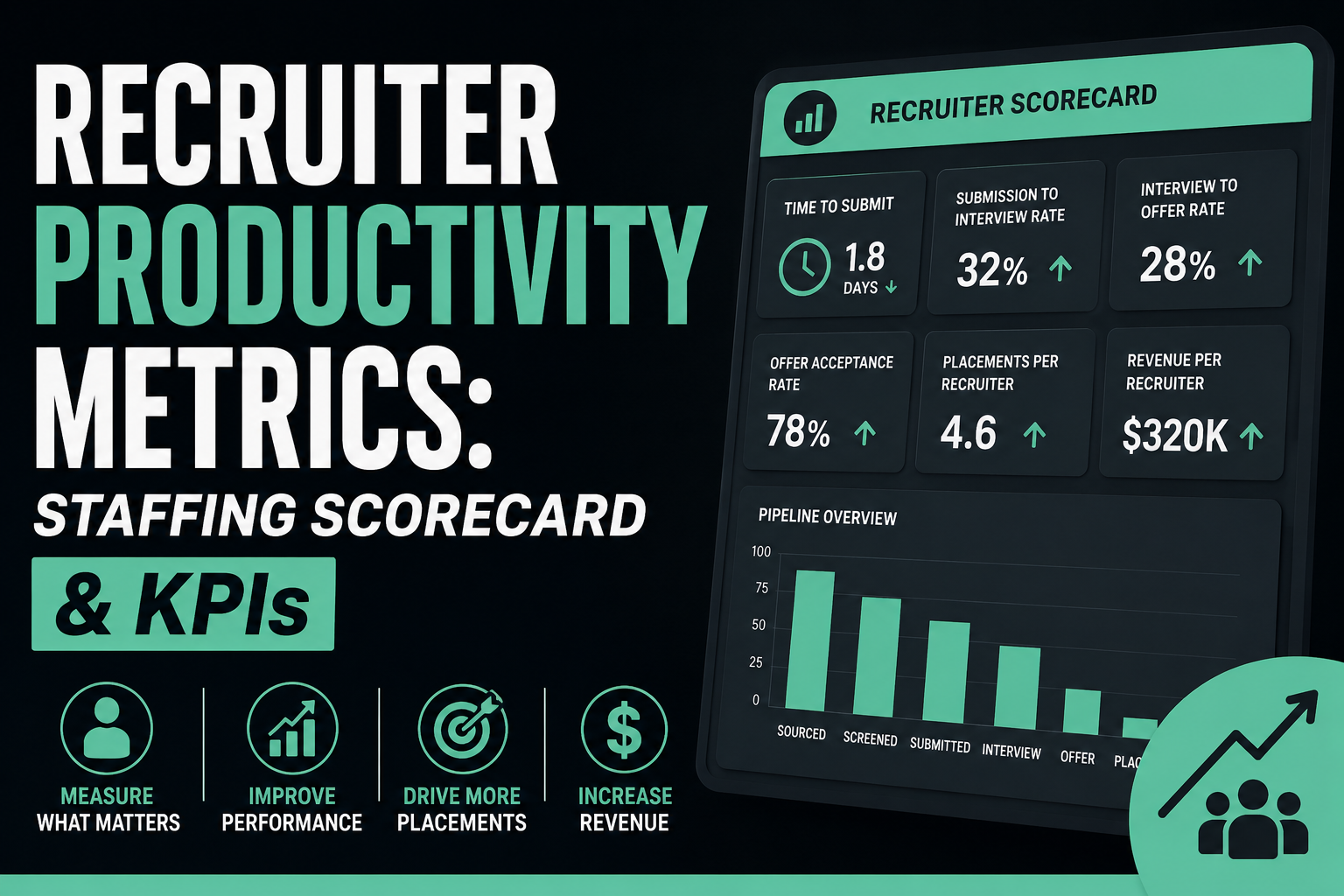
Submission-to-interview, interview-to-offer, and offer-to-placement rates are the clearest window into where the funnel is actually leaking, independent of how busy a desk looks.
Speed
Time to first submit and time to fill capture how quickly activity turns into movement — slow speed often means administrative drag, not lack of effort.
Output
Placements per recruiter, revenue per recruiter and gross profit per recruiter are the outcome-level numbers that ultimately matter to the business.
Quality
Candidate retention, client satisfaction and redeployment rate reveal whether placements are actually sticking, and whether past candidates are being reused effectively instead of resourced from scratch every time.
Stop Measuring Recruiters by Activity Alone
Every metric below on the left is easy to track and easy to misread. The one next to it is closer to what actually predicts revenue.
| Vanity metric | Better metric |
|---|---|
| Calls made | Qualified conversations |
| Emails sent | Candidate response rate |
| Profiles sourced | Qualified candidates |
| CVs submitted | Submission-to-interview rate |
| Interviews scheduled | Interview-to-offer rate |
| Placements | Revenue/gross profit per recruiter |
Managing to activity metrics alone tends to produce exactly the behavior you'd expect: more calls, more emails, more submissions, with no guarantee any of it is aimed at the right candidates or the right jobs. A recruiter can hit every activity target on a scorecard and still underperform on revenue, because the scorecard was measuring motion instead of progress.
Where Staffing Agencies Usually Lose Placements
| What you see | Looks like | What may actually be wrong |
|---|---|---|
| Lots of candidates, few interviews | High sourcing | Poor qualification |
| Many submissions, few interviews | High activity | Weak matching |
| Good interviews, few offers | Strong pipeline | Candidate/client mismatch |
| Offers, few starts | Good closing | Candidate engagement |
| Good placements, poor margin | Revenue looks healthy | Job economics |
| Recruiters constantly busy | High activity | Administrative overload |
| Fast sourcing, slow submission | Candidate volume | Workflow friction |
Each of these patterns points somewhere specific. High sourcing with few interviews is almost never a sourcing problem — it's usually qualification or matching happening too loosely upstream. Good placements with poor margin isn't a recruiter performance issue at all; it's a pricing and job-order economics issue that shows up looking like a productivity problem. Reading the pattern correctly matters more than reacting to the surface-level number.
How Administrative Work Reduces Recruiter Productivity
ATS updates, resume review, duplicate data entry across systems, scheduling coordination, manual follow-ups, candidate status changes, reporting, and sourcing across multiple disconnected platforms all compete for the same hours a recruiter would otherwise spend on candidate conversations, client relationships, qualification, negotiation and closing.
None of this shows up as a single dramatic problem. It shows up as a recruiter who's genuinely busy all day and still behind on the calls that actually move a placement forward. The fix isn't necessarily "work faster." It's usually reducing how much of the day gets absorbed by repetitive coordination work that doesn't require recruiter judgment in the first place.
How AI Can Improve Staffing Agency Productivity
The practical applications are narrower than the marketing around AI recruiting tools usually suggests, but they're real in the specific parts of the workflow where volume and repetition are highest.
Sourcing: finding and prioritizing candidates against a role's requirements faster than manual search. Matching: comparing candidate profiles against job requirements to surface the strongest fits first. Screening: handling repeatable qualification steps before a recruiter's time gets involved. Outreach: personalizing and automating follow-up sequences so candidates stay engaged without a recruiter tracking every touchpoint manually. Scheduling: reducing the back-and-forth of coordinating interviews. Rediscovery: surfacing relevant candidates who already exist in the database instead of resourcing a role from zero.
The right way to think about this: AI should remove repetitive work while leaving recruiters responsible for judgment, relationships and final decisions. It doesn't replace the recruiter, and framing it that way tends to set up unrealistic expectations that undermine adoption.
What Should You Automate First?
A useful way to prioritize automation is to weigh tasks by volume, repetition, time cost and standardization — the higher a task scores across those factors, the better an early automation candidate it is.
- Candidate sourcing
- Candidate rediscovery
- Initial outreach
- Follow-ups
- Resume screening
- Scheduling
- Status updates
- Reporting
These tasks are high-volume, repetitive, and relatively low-risk if something needs a second look. Judgment-heavy decisions — who actually gets submitted, how an offer gets negotiated — should keep stronger human oversight regardless of how automated the rest of the workflow becomes.
How to Diagnose a Productivity Problem Before Hiring More Recruiters
Adding headcount is often the default response to flat placement numbers, and it's frequently the wrong first move. Before hiring, work through these questions:
- Are current job orders adequately qualified? A recruiter can't outperform a vague or unrealistic requisition.
- Where does the funnel lose candidates? Pin the stage down before assuming you know the cause.
- How much recruiter time is spent on administrative work? This is often larger than leadership assumes.
- Are submissions converting into interviews? If not, the issue is likely matching or submission quality, not volume.
- Are interviews converting into offers? A gap here usually points to expectation mismatches set earlier in the process.
- Are offers converting into starts? Late-stage drop-off is often about candidate engagement, not the offer itself.
- Are recruiters working the highest-value jobs? Time spent on low-probability or low-margin roles is time not spent where it counts.
If the honest answers point to a weak spot in the funnel rather than a lack of hands, another recruiter working the same broken process will likely just produce more of the same pattern at a higher cost.
A Simple Staffing Agency Productivity Scorecard
A weekly view across these categories gives a staffing leader a fast read on where to look next, without requiring a complex reporting system.
| Category | Metric |
|---|---|
| Demand | New job orders |
| Sourcing | Qualified candidates |
| Speed | Time to first submit |
| Quality | Submission-to-interview |
| Conversion | Interview-to-offer |
| Conversion | Offer-to-placement |
| Output | Placements/recruiter |
| Financial | Revenue/recruiter |
| Efficiency | Admin hours |
| Client | Fill rate |
Don't import an external benchmark for any of these. Establish your own baseline first, then compare it across similar desks, similar roles, similar time periods and similar recruiter responsibilities. A number that looks low in isolation might be completely normal for a particular niche or market.
How to Improve Staffing Agency Productivity Without Hiring More Recruiters
Step 1: Map the workflow. Write out what actually happens between a job order landing and a placement closing, stage by stage.
Step 2: Find the lowest-converting stage. Use your own numbers, not assumptions, to identify where the funnel narrows the most sharply relative to the stage before it.
Step 3: Separate activity from outcome. Look at conversion rates at that stage specifically, not overall busyness.
Step 4: Remove repetitive administrative work. Identify what's eating recruiter time that doesn't require recruiter judgment, and reduce or automate it.
Step 5: Improve qualification. If sourcing-to-qualification is weak, tighten screening criteria and make sure recruiters have accurate job information before they start.
Step 6: Improve candidate matching. If submission-to-interview is weak, the issue is usually fit, not volume — review what's actually getting submitted and why.
Step 7: Automate repetitive follow-up. Keep candidates engaged through the pipeline without recruiters manually tracking every touchpoint.
Step 8: Measure again after 30 days. Compare the same funnel stage against its prior baseline to confirm whether the change actually moved the number.
Staffing Agency Productivity Assessment
Ninjahire Staffing Productivity Assessment — this is a practical Ninjahire assessment framework, not an industry benchmark. Answer each question, then see where your agency stands on visibility into its own funnel.
The Staffing Productivity Funnel and Two Other Ways to Frame the Problem
Three concepts run through this article worth naming explicitly, because they're useful shorthand once you're looking at your own numbers. These are practical Ninjahire frameworks built for this analysis, not established industry standards.
The Staffing Productivity Funnel
Job Order → Candidate → Submission → Interview → Offer → Placement → Revenue. The framework used throughout this guide to locate exactly where activity stops converting into outcomes.
The Activity-to-Outcome Ratio
Instead of asking how busy a recruiter is, ask how much commercial output each unit of recruiter activity actually creates. Two recruiters with identical call volume can have very different ratios, and the ratio is the more useful number to manage to.
The Placement Bottleneck Test
A simple diagnostic: identify the single lowest-converting stage in your funnel before drawing any conclusion about recruiters, clients, or candidates. The bottleneck tells you where to look, not automatically why it's happening.
None of this replaces good technology and process underneath it. A lot of what limits staffing agency productivity in practice comes down to the systems recruiters are working in day to day — how much of the funnel a team can even see, and how much manual work sits between each stage. That's covered in more depth in this guide to staffing agency software, which looks at the technology infrastructure question this article doesn't go deep on.
Frequently Asked Questions
What is staffing agency productivity?
Staffing agency productivity is the amount of commercially valuable output — placements, revenue, gross profit, or qualified submissions — generated relative to recruiter capacity, rather than simply how much activity a recruiter performs.
How do you measure staffing agency productivity?
By tracking conversion rates through the placement funnel (sourcing to qualification to submission to interview to offer to placement) alongside output measures like placements, revenue and gross profit per recruiter — not activity counts alone.
What are the most important recruiter productivity metrics?
Submission-to-interview rate, interview-to-offer rate, offer-to-placement rate, time to first submit, and revenue or gross profit per recruiter are generally the most diagnostic, since they show conversion rather than raw volume.
How can staffing agencies increase recruiter productivity?
By identifying the specific funnel stage where conversion is weakest, addressing the root cause at that stage (qualification, matching, administrative load, or candidate engagement), and reducing repetitive work that doesn't require recruiter judgment.
What is a good placement rate for a staffing agency?
There's no universal number. Placement rate depends heavily on how the denominator is defined, the staffing model, role type, market, job order quality, and whether the desk runs contract or direct-hire — healthcare and executive search, for example, produce very different rates than high-volume IT staffing.
How many placements should a recruiter make?
This varies too widely to state as one number. It depends on role complexity, average deal size, contract versus direct-hire mix, and how much of a recruiter's time goes to sourcing versus account management. Compare a recruiter against their own historical baseline and similar peers rather than an industry-wide figure.
How does AI improve recruiter productivity?
By automating the high-volume, repetitive parts of the workflow — sourcing, matching, initial screening, outreach and scheduling — so recruiters spend more time on judgment-heavy work like qualification calls, client relationships and closing.
What is the difference between recruiter activity and recruiter productivity?
Activity measures effort — calls made, emails sent, candidates sourced. Productivity measures how much of that effort converts into commercially valuable outcomes like interviews, offers and placements.
How do you identify a staffing agency productivity bottleneck?
By calculating conversion rates at each stage of the funnel — sourcing to qualification, qualification to submission, submission to interview, interview to offer, offer to placement — and finding the stage where the drop-off is largest relative to the volume entering it.
What This Actually Comes Down To
If your recruiters are spending too much time sourcing, screening, following up and moving information between systems, adding more recruiters probably won't fix what's actually broken. It usually just adds more people running the same leaky funnel.
Reducing the repetitive work around the recruiter — sourcing, matching, initial outreach, coordination — gives the people already on your team more time for the parts of the job that actually close placements: conversations, relationships, and judgment calls a system can't make for them. Try Ninjahire Free to see how that fits into the workflow you're already running.