.png)

If you run recruiting operations at a staffing agency, you already know the uncomfortable math. Every year, your recruiters source, screen, and interview thousands of candidates. Most of them never get placed. Not because they weren't qualified, but because the role they were right for closed, or a client changed requirements, or timing didn't line up. Those candidates don't disappear. They sit in your ATS, in spreadsheets, in old email threads, effectively invisible the next time a similar role opens.
Talent pool management software exists to fix exactly that gap. It's the layer that sits between your ATS and your recruiters, turning a static candidate database into something recruiters actually search, segment, and act on. This guide covers what it is, how it works, what separates good tools from mediocre ones, and how agencies of different sizes are using it today.
What Is Talent Pool Management Software?
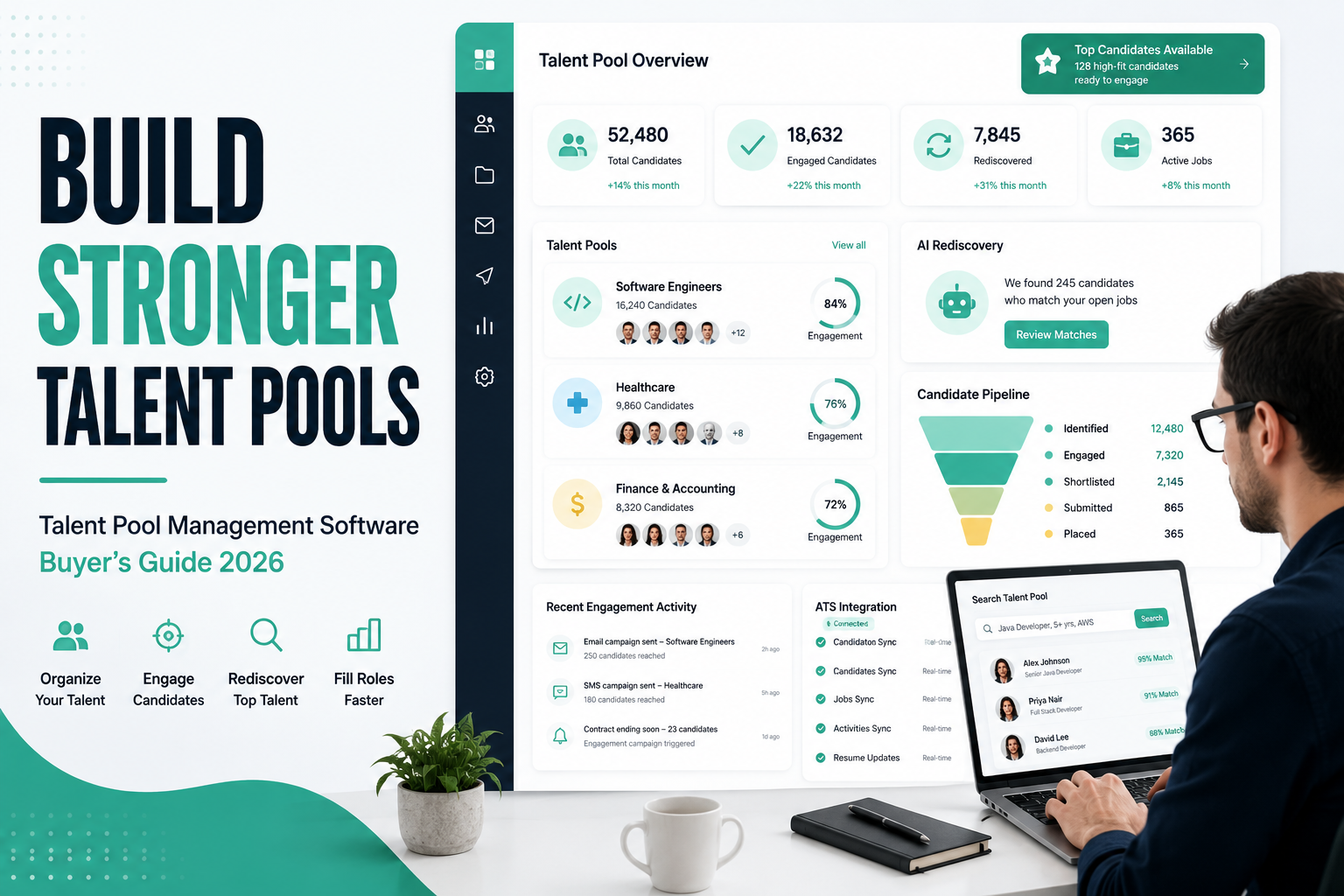
Talent pool management software is a system that organizes candidates from your ATS and other sourcing channels into structured, searchable groups (talent pools) based on skills, experience, availability, and past client fit, then keeps those candidates engaged over time so recruiters can quickly find and re-activate them for new openings instead of sourcing from scratch.
It typically layers on top of your existing ATS rather than replacing it. Your ATS still tracks candidates through the active hiring stages for a specific job order. The talent pool layer handles everything that happens before and after that: organizing your full candidate history, running semantic search across resumes and notes, flagging candidates who match a new job description, and automating outreach to people who've gone quiet.
For agencies working dozens of open requisitions at once, this distinction matters. An ATS answers "where is this candidate in this specific pipeline?" A talent pool tool answers "who in our entire database, across every job we've ever worked, fits this new role?"
Why Staffing Agencies Need Talent Pool Management
Staffing is a volume business with a short memory problem. A recruiter who screened 40 candidates for a helpdesk role in March has no easy way to recall which three of them would be a strong fit for a similar role in October, unless they happen to remember the names or dig through old notes. Multiply that across a desk of ten recruiters working hundreds of roles a year, and the amount of usable candidate knowledge that gets lost is substantial.
There's also a cost dimension. Sourcing a new candidate from job boards, LinkedIn, or referral networks takes time and often a paid credit. Rediscovering a candidate you've already vetted costs nothing but a search query. Agencies that lean on talent pools consistently report shorter time-to-submit because a meaningful share of every requisition gets filled from candidates already in the system, not fresh sourcing.
Clients notice the difference too. An agency that can present three strong, previously-vetted candidates within 24 hours of receiving a job order looks fundamentally more capable than one that starts sourcing cold every time. That speed is often the actual differentiator in competitive MSP and VMS relationships, where multiple agencies are racing for the same requisition.
How Talent Pool Management Works
The mechanics are consistent across most tools, even if the interfaces differ. A candidate enters the system, gets parsed and categorized, and becomes part of one or more pools that recruiters can search and act on later.
Resume parsing extracts structured data from an unstructured document: job titles, dates, certifications, tools, and industries. Skill extraction goes a level deeper, pulling out specific competencies (say, "Epic EHR" for a healthcare candidate or "SOC 2 audit" for a compliance hire) that may not appear as a clean keyword. AI segmentation then groups candidates by these attributes plus behavioral signals like responsiveness and past placement outcomes.
Once a candidate is in a pool, engagement tools keep the relationship alive: newsletters, targeted role alerts, check-in messages timed around contract end dates. When a new job order comes in, candidate matching runs the requirement against the pool and surfaces ranked candidates, including people who never applied to that specific job. Rediscovery is what happens when a recruiter searches "React developer, healthcare industry, available in 30 days" and gets back candidates from jobs closed a year ago.
Talent Pool Management vs Traditional ATS
It's a fair question whether you need both. In practice, the two systems solve different problems, and most staffing agencies running above a certain volume end up needing both working together.
| Capability | Traditional ATS | Talent Pool Management |
|---|---|---|
| Primary purpose | Move candidates through one job's hiring stages | Organize and reuse the entire candidate database |
| Search scope | Usually per-job or keyword-based | Semantic, cross-job, skill and context aware |
| Candidate history | Stored, rarely resurfaced automatically | Actively resurfaced through rediscovery and matching |
| Engagement | Manual or basic status emails | Automated nurture via email and SMS |
| Segmentation | Static tags or folders | Dynamic, AI-driven pools that update as data changes |
| Best for | Compliance, pipeline tracking, client submittals | Sourcing cost reduction, speed to submittal, reactivation |
The two are meant to sync, not compete. Candidate records created in the ATS flow into the talent pool layer, and placements or status changes flow back. Agencies that treat talent pool software as a bolt-on rather than an integrated system tend to end up with two disconnected candidate lists, which defeats the purpose.
Key Features to Look For
Candidate Database
A unified, deduplicated record of every candidate you've sourced, screened, or placed, pulled from your ATS and other channels into one searchable system.
Resume Parsing
Automatic extraction of structured data from resumes so candidates are searchable by skill, title, certification, and tenure rather than raw keywords alone.
Semantic Search
Search that understands intent and context, so "senior backend engineer, fintech" returns relevant candidates even without an exact keyword match.
Candidate Rediscovery
Surfaces previously sourced or interviewed candidates who fit a new opening, even ones who never applied to that specific job.
Candidate Engagement
Ongoing communication that keeps candidates warm between roles, so they respond when a recruiter reaches out months later.
Email Automation
Triggered sequences for onboarding, role alerts, and re-engagement, without a recruiter manually drafting each message.
SMS Automation
Text-based outreach for time-sensitive updates, given how much faster candidates respond to text than email in staffing.
Workflow Automation
Rules-based actions, like auto-tagging a candidate as "hot" after an interview or notifying a recruiter when a contract end date approaches.
Analytics
Visibility into pool health, submittal-to-placement ratios, and how much of your pipeline comes from rediscovery versus new sourcing.
ATS Synchronization
Two-way sync that keeps candidate status, notes, and job history consistent between the talent pool tool and your ATS of record.
Benefits for Staffing Agencies
- Recruiter productivity: less time spent re-sourcing candidates who already exist in the system.
- Lower sourcing costs: fewer paid job board credits and less reliance on external databases.
- Faster hiring: submittals built from a warm, pre-vetted pool rather than a cold start.
- Higher ATS utilization: the candidates you already paid to source and screen actually get used more than once.
- Better candidate experience: consistent communication instead of candidates going silent after one rejection.
- Better placement quality: matching based on documented skills and past performance, not just resume keywords.
ATS Integrations
Talent pool software is only as useful as the data it can pull in, so integration with your existing ATS matters as much as the features on top of it. The most common ATS platforms in staffing today include Bullhorn, CEIPAL, JobDiva, and Avionté, alongside Recruit CRM for smaller agencies and Greenhouse, Lever, or Workday for corporate and RPO environments.
| ATS | Common Use Case | Integration Consideration |
|---|---|---|
| Bullhorn | Mid-to-large staffing agencies | Widely supported via native or marketplace connectors |
| CEIPAL | IT and healthcare staffing | API-based sync for candidate and job data |
| JobDiva | High-volume contract staffing | Strong resume database, check parsing compatibility |
| Avionté | Light industrial and clerical staffing | Payroll-adjacent data adds sync complexity |
| Recruit CRM | Boutique and executive search firms | Simpler data model, faster initial setup |
| Greenhouse / Lever / Workday | Corporate TA and RPO | Often governed by stricter data access policies |
Before buying, confirm whether integration is a native two-way sync or a one-way export, since one-way integrations mean recruiters end up working in two disconnected systems, which recreates the exact problem talent pool software is meant to solve.
Industry Use Cases
IT Staffing
Fast-moving contract roles with narrow technical skill requirements make rediscovery especially valuable, since the same skill sets recur across clients.
Healthcare
Licensure, certifications, and compliance windows make structured candidate data essential, and pools help track who's credentialed and available.
Engineering
Specialized, scarce skill sets mean the same qualified candidates resurface across multiple job orders over a year or more.
Finance
Compliance-sensitive roles benefit from documented candidate history and consistent, auditable communication trails.
Manufacturing
High-volume, recurring roles with seasonal demand make talent pools a direct way to reduce repeat sourcing costs.
Executive Search
Long relationship cycles mean candidates from a search two years ago may be exactly right for a new mandate today.
Contract Staffing
Candidates cycle in and out of assignments constantly, so knowing who's coming off contract soon is a built-in sourcing pipeline.
Talent Pool Management vs Other Categories
It helps to place talent pool management alongside adjacent tools agencies already know, since the terminology overlaps in ways that cause confusion during evaluation.
vs ATS
Covered above: an ATS tracks a candidate through one job's stages. Talent pool software organizes the full candidate base across every job.
vs Recruiting CRM
A recruiting CRM manages relationships, often with clients as well as candidates, and focuses on communication history and pipeline stages. Talent pool tools overlap here but go further on structured segmentation and matching logic specifically for candidates.
vs Candidate Database
A candidate database is a storage layer. Talent pool management is what makes that storage layer actionable, through search, segmentation, and automated engagement.
vs Candidate Rediscovery Tools
Rediscovery is one feature within talent pool management, not a category on its own. Standalone rediscovery tools tend to be narrower, focused purely on surfacing old resumes without the broader engagement and segmentation layer.
vs Candidate Matching Engines
Matching engines rank candidates against a job description. Talent pool management includes matching but also covers what happens before (organizing the pool) and after (engaging and tracking outcomes).
Implementation Best Practices
- Start with a data cleanup pass before migration, since duplicate or outdated candidate records reduce match quality from day one.
- Map your existing ATS fields to the new system's schema before going live, rather than discovering mismatches after launch.
- Pilot with one desk or one industry vertical first, so recruiters can give feedback before a company-wide rollout.
- Set clear rules for what triggers a candidate to move between pools, so segmentation doesn't drift into inconsistency.
- Train recruiters on search behavior specifically, since semantic search works differently than keyword search they're used to.
- Review engagement automation copy before it goes live, since generic templates read as impersonal to candidates.
- Revisit pool definitions quarterly as your client mix and job types shift.
How NinjaHire Supports Talent Pool Management
NinjaHire was built around the specific workflow described in this guide: candidates come in through your existing ATS, get parsed and organized into pools automatically, and stay reachable through built-in email and SMS sequences that recruiters can adjust without needing a developer. It connects with Bullhorn, CEIPAL, JobDiva, Avionté, and Recruit CRM, syncing candidate records both ways so your ATS stays the system of record while NinjaHire handles search, segmentation, and rediscovery on top.
Where it tends to help most is on desks juggling a high volume of similar roles, where the same qualified candidates come up again and again across different clients. Recruiters search using plain language rather than exact keyword strings, and the system surfaces ranked matches from anywhere in the candidate history, not just people who applied to the current job order. Agencies typically start with one desk, measure how much of their pipeline shifts from cold sourcing to warm rediscovery, and expand from there.
Frequently Asked Questions
What is talent pool management software?
It's software that organizes candidates you've already sourced or placed into searchable, segmented groups, then keeps them engaged over time so recruiters can find and re-activate qualified people without sourcing from scratch for every new role.
Is talent pool management software the same as an ATS?
No. An ATS tracks a candidate through the stages of one specific job. Talent pool software organizes and reuses your entire candidate database across every job you've ever worked, which is a different function.
Does talent pool software replace my ATS?
No, it works alongside your ATS and syncs with it. Your ATS remains the system of record for active job orders, while the talent pool layer handles long-term organization, rediscovery, and candidate engagement.
Which ATS platforms does talent pool software typically integrate with?
Common integrations include Bullhorn, CEIPAL, JobDiva, Avionté, and Recruit CRM, along with Greenhouse, Lever, and Workday in corporate and RPO settings.
How is this different from a recruiting CRM?
A recruiting CRM focuses on relationship and communication tracking, often including clients. Talent pool management goes further on structured candidate segmentation and cross-job matching specifically.
What is candidate rediscovery?
Rediscovery is the process of surfacing previously sourced or interviewed candidates who fit a new job opening, including people who never applied to that specific role.
How does semantic search differ from keyword search?
Keyword search matches exact terms. Semantic search understands context and intent, so a query like "senior backend engineer, fintech" returns relevant candidates even without that exact phrase in their resume.
Does talent pool software use AI resume screening?
Most modern tools use AI to parse resumes, extract skills, and rank candidates against a job description, though the degree of automation versus recruiter review varies by vendor.
How long does implementation usually take?
Timelines vary by agency size and data volume, but a single-desk pilot with a clean ATS integration commonly takes a few weeks from kickoff to recruiters actively using it.
Will my recruiters need to learn a new interface?
Yes, there's a learning curve, particularly around semantic search behavior, though most agencies find recruiters adapt within the first few weeks of regular use.
Can talent pool software reduce sourcing costs?
Yes, by filling a share of open roles from candidates already in the database rather than new paid sourcing, agencies typically see a measurable drop in job board spend.
Does it work for contract and temp staffing, not just direct hire?
Yes, and in some ways it's more valuable there, since contract candidates cycle in and out of assignments regularly and represent a built-in pipeline of soon-to-be-available talent.
How does candidate segmentation actually work?
Candidates are grouped by attributes like skills, certifications, industry, availability, and past client fit, with AI-driven segmentation updating pools automatically as new data comes in.
What is candidate engagement automation?
It's automated email and SMS communication, like role alerts or check-ins timed around contract end dates, that keeps candidates responsive without a recruiter manually reaching out to everyone.
Is SMS automation actually necessary, or is email enough?
It depends on your candidate pool, but staffing candidates in general tend to respond to text messages faster than email, which makes SMS useful for time-sensitive openings.
How does talent pool software handle compliance-sensitive industries like healthcare?
It typically tracks structured fields like licensure and certification expiration dates, helping recruiters filter for compliant, available candidates without manual cross-checking.
What analytics should I expect from a talent pool tool?
Look for visibility into pool health, submittal-to-placement ratios, and the share of your pipeline coming from rediscovery versus new sourcing, since that ratio is the clearest measure of ROI.
Can talent pool software integrate with more than one ATS at once?
Many agencies, especially those that grew through acquisition, run more than one ATS, so it's worth confirming multi-ATS support before buying if that applies to you.
Does this help with MSP or VMS relationships?
Yes, faster submittals built from a warm, pre-vetted pool are often the deciding factor in competitive MSP and VMS environments where multiple agencies compete for the same requisition.
How is data migrated from my existing ATS?
Most vendors handle initial sync through API integration, pulling candidate records, resumes, and job history, though a data cleanup pass beforehand improves match quality significantly.
What happens to duplicate candidate records?
Good talent pool software includes deduplication logic during import and ongoing sync, merging records that represent the same person across different sourcing channels.
Is talent pool software suitable for small or boutique agencies?
Yes, though the return is proportional to volume; agencies working a high number of similar roles tend to see faster payback than those doing occasional, highly bespoke searches.
How does candidate matching differ from a basic keyword filter?
Candidate matching considers skills, context, and prior performance signals together, ranking candidates by overall fit rather than simply filtering by exact keyword overlap.
Can recruiters override AI-suggested matches?
Yes, in any well-designed system recruiters can adjust, override, or manually search outside of AI suggestions, since recruiter judgment remains part of the process.
What should I evaluate first when comparing vendors?
Start with ATS integration depth (native two-way sync versus a basic export) since that determines whether the tool becomes a genuine extension of your workflow or a second disconnected system.
How does NinjaHire fit into this?
NinjaHire connects to ATS platforms like Bullhorn, CEIPAL, JobDiva, and Avionté, organizing candidates into pools automatically and keeping them engaged through built-in email and SMS, so recruiters can search and rediscover candidates without leaving their existing workflow.